What you'll learn
- The Python syntax and built-in types you reach for every day
- Compact tables for strings, lists, dicts and sets
- Comprehensions, functions, classes, files and exceptions at a glance
- A short tour of the most useful standard library modules
Keep this page open while you code. Each section is a reminder, not a full lesson. Follow the course lessons for the explanations.
Syntax basics
| Idea | Example |
|---|---|
| Comment | # a comment |
| Variable | age = 30 |
| Multiple assign | a, b = 1, 2 |
| Swap | a, b = b, a |
| Types | int, float, str, bool, list, tuple, dict, set, None |
| Check type | type(x), isinstance(x, int) |
| Convert | int("5"), float("1.5"), str(10), list("abc") |
| Arithmetic | + - * / // % ** |
| Compare | == != < > <= >= |
| Logic | and, or, not |
| Membership | x in items, x not in items |
x = 7
if x > 10:
    print("big")
elif x > 5:
    print("medium")
else:
    print("small")

for i in range(3):          # 0, 1, 2
    print(i)

n = 3
while n > 0:
    n -= 1

for i, ch in enumerate("abc"):
    print(i, ch)
Strings
| Task | Code |
|---|---|
| Length | len(s) |
| Upper, lower | s.upper(), s.lower(), s.title() |
| Strip spaces | s.strip(), s.lstrip(), s.rstrip() |
| Split, join | s.split(","), "-".join(parts) |
| Replace | s.replace("a", "b") |
| Find | s.find("x") (returns -1 if missing), s.index("x") |
| Test | s.startswith("a"), s.endswith("z"), s.isdigit() |
| Slice | s[0:3], s[-1], s[::-1] |
| Count | s.count("a") |
name = "Ada"
score = 93.456
print(f"{name} scored {score:.1f}")     # Ada scored 93.5
print(f"{score:>10.2f}")                # right aligned
print("a,b,c".split(","))               # ['a', 'b', 'c']
print("-".join(["x", "y"]))             # x-y
Lists
| Task | Code |
|---|---|
| Create | nums = [3, 1, 2] |
| Add | nums.append(4), nums.insert(0, 9), nums.extend([5, 6]) |
| Remove | nums.remove(1), nums.pop(), nums.pop(0), del nums[0] |
| Sort | nums.sort() (in place), sorted(nums) (new list) |
| Reverse | nums.reverse(), nums[::-1] |
| Slice | nums[1:3], nums[:2], nums[-2:] |
| Info | len(nums), min(nums), max(nums), sum(nums) |
| Search | nums.index(2), nums.count(2), 2 in nums |
| Copy | nums.copy() or nums[:] |
Tuples
Tuples are immutable lists: point = (3, 4). Unpack them with x, y = point.
Dictionaries
| Task | Code |
|---|---|
| Create | d = {"a": 1, "b": 2} |
| Read | d["a"], d.get("z", 0) |
| Set | d["c"] = 3 |
| Delete | del d["a"], d.pop("b") |
| Loop | d.keys(), d.values(), d.items() |
| Merge | d1 | d2, d.update(other) |
| Check key | "a" in d |
prices = {"apple": 3, "pear": 5}
for fruit, price in prices.items():
    print(fruit, price)

counts = {}
for ch in "banana":
    counts[ch] = counts.get(ch, 0) + 1
print(counts)       # {'b': 1, 'a': 3, 'n': 2}
Sets
| Task | Code |
|---|---|
| Create | s = {1, 2, 3}, set([1, 1, 2]), empty: set() |
| Add, remove | s.add(4), s.discard(1) |
| Union | a | b |
| Intersection | a & b |
| Difference | a - b |
| Symmetric difference | a ^ b |
Sets hold unique values and check membership very quickly. Use them to remove duplicates: list(set(items)).
Comprehensions
squares = [n * n for n in range(5)]                 # [0, 1, 4, 9, 16]
evens = [n for n in range(10) if n % 2 == 0]        # [0, 2, 4, 6, 8]
lengths = {w: len(w) for w in ["hi", "python"]}     # dict comprehension
unique = {c for c in "hello"}                       # set comprehension
total = sum(n for n in range(100))                  # generator expression
Functions
def greet(name, greeting="Hello"):
    """Return a greeting."""
    return f"{greeting}, {name}!"

def total(*numbers, **options):
    return sum(numbers)

square = lambda x: x * x

print(greet("Ada"))
print(greet("Ada", greeting="Hi"))
print(total(1, 2, 3))
print(list(map(square, [1, 2, 3])))| Concept | Syntax |
|---|---|
| Default argument | def f(a, b=2) |
| Variable positional | def f(*args) |
| Variable keyword | def f(**kwargs) |
| Unpack call | f(*items), f(**options) |
| Type hints | def f(a: int) -> str |
| Lambda | lambda x: x + 1 |
Never use a mutable default such as def f(items=[]). Use None and create the list inside the function.
Classes
class Dog:
    species = "canine"            # class attribute

    def __init__(self, name):
        self.name = name          # instance attribute

    def speak(self):
        return f"{self.name} says woof"

    def __repr__(self):
        return f"Dog({self.name!r})"

class Puppy(Dog):                 # inheritance
    def speak(self):
        return super().speak() + " softly"

print(Puppy("Rex").speak())| Method | Purpose |
|---|---|
__init__ | Set up a new object |
__str__, __repr__ | Readable and debug text |
__len__ | Support len(obj) |
__eq__ | Support == |
@staticmethod | Method with no self |
@classmethod | Method that receives the class |
@property | Method used like an attribute |
Files
with open("notes.txt", "w", encoding="utf-8") as f:
    f.write("hello\n")

with open("notes.txt", encoding="utf-8") as f:
    for line in f:
print(line.strip())| Mode | Meaning |
|---|---|
"r" | Read (default) |
"w" | Write, replaces the file |
"a" | Append |
"rb", "wb" | Binary read and write |
Exceptions
try:
    value = int("abc")
except ValueError as err:
    print("bad number:", err)
except (TypeError, KeyError):
    print("type or key problem")
else:
    print("no error")
finally:
    print("always runs")

raise ValueError("something is wrong")| Common exception | Typical cause |
|---|---|
ValueError | Right type, wrong value, such as int("x") |
TypeError | Wrong type, such as 1 + "a" |
KeyError | Missing dict key |
IndexError | List index out of range |
FileNotFoundError | File does not exist |
ZeroDivisionError | Division by zero |
Common standard library
| Module | Handy for | Example |
|---|---|---|
math | Maths functions | math.sqrt(16) |
random | Random numbers | random.choice(items) |
datetime | Dates and times | datetime.now() |
json | JSON text | json.loads(text), json.dumps(obj) |
os, pathlib | Paths and folders | Path("a") / "b.txt" |
sys | Interpreter info | sys.argv |
re | Regular expressions | re.findall(r"\d+", s) |
collections | Counter, defaultdict, deque | Counter("banana") |
itertools | Iteration helpers | itertools.chain(a, b) |
csv | CSV files | csv.reader(f) |
from collections import Counter
from pathlib import Path
import json

print(Counter("banana").most_common(1))     # [('a', 3)]
print(json.dumps({"a": 1}))                 # {"a": 1}
print(Path("data") / "file.txt")
Handy built-ins
len, range, enumerate, zip, sorted, reversed, sum, min, max, any, all, map, filter, abs, round, input, print, open, isinstance.
>>> list(zip([1, 2], ["a", "b"]))
[(1, 'a'), (2, 'b')]
>>> any(n > 2 for n in [1, 2, 3])
True
Check what you learned
What does [n * n for n in range(4)] produce?
range(4) yields 0, 1, 2, 3 and each one is squared, giving 0, 1, 4, 9.
Show answer
B — [0, 1, 4, 9] — range(4) yields 0, 1, 2, 3 and each one is squared, giving 0, 1, 4, 9.
Which is the safest way to read a dictionary key that might be missing?
d.get returns the default instead of raising KeyError when the key is absent.
Show answer
B — d.get(key, default) — d.get returns the default instead of raising KeyError when the key is absent.
Why use a with statement to open a file?
with is a context manager. It guarantees the file is closed when the block ends, whether it ends normally or with an exception.
Show answer
C — It closes the file automatically, even if an error happens — with is a context manager. It guarantees the file is closed when the block ends, whether it ends normally or with an exception.
Credits
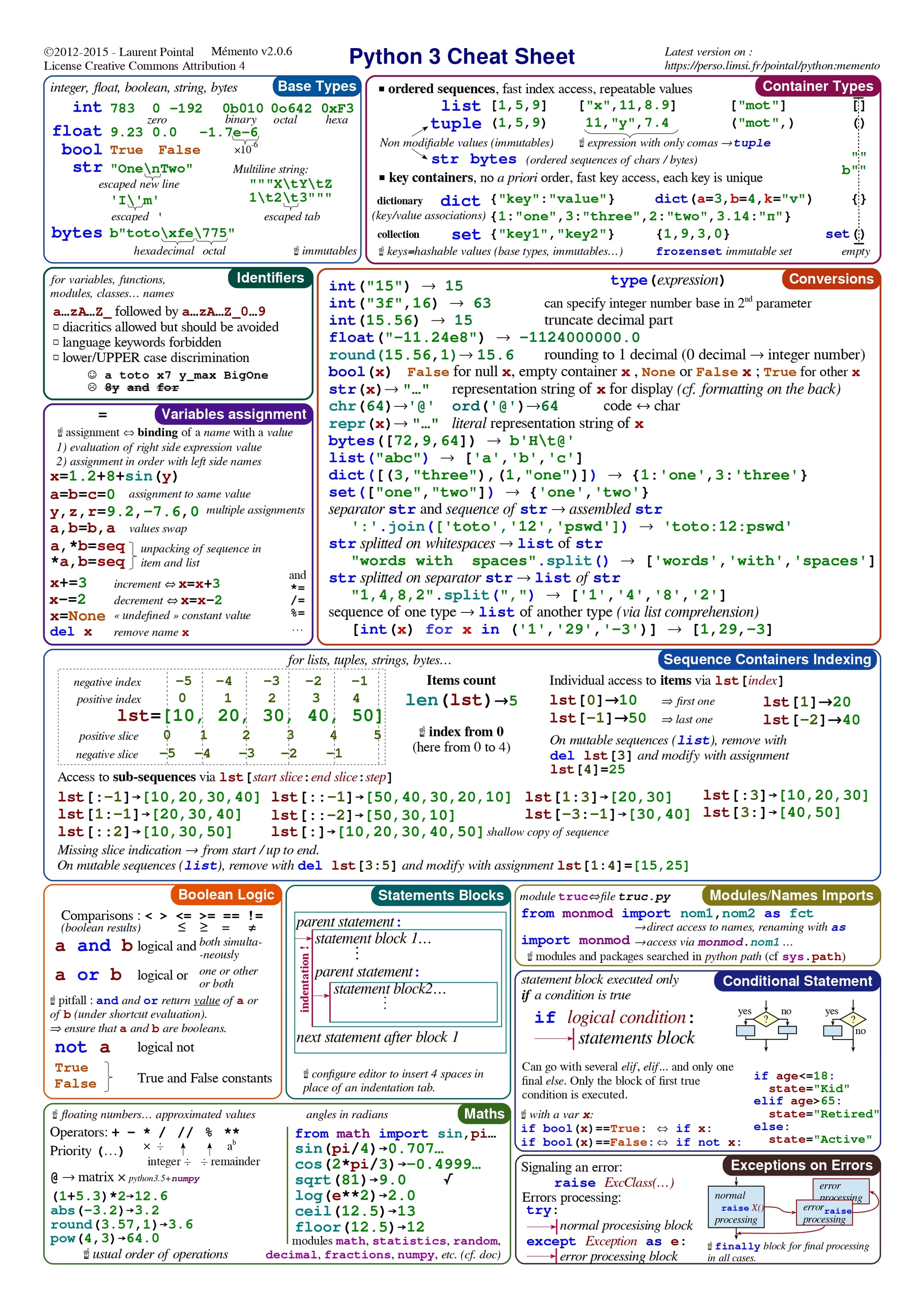
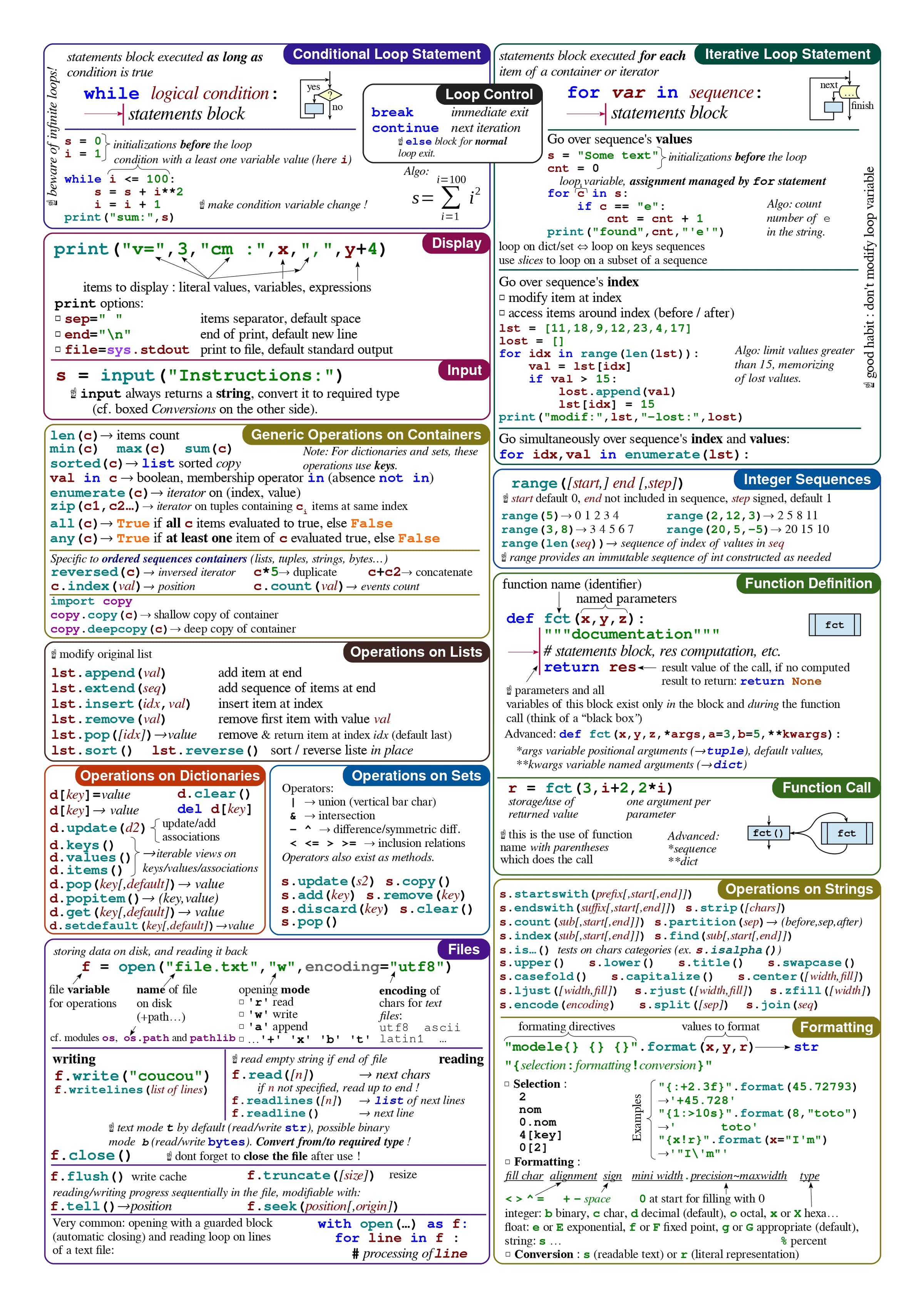
The original printable memento below is by Laurent Pointal.