
Named Entity Recognition (NER)
Named entity recognition tags each token with the span it belongs to: mary/B-PER okafor/I-PER joined/O acme/B-ORG industries/I-ORG. It looks like classification with
more labels, and that resemblance is exactly what makes it easy to measure wrongly.
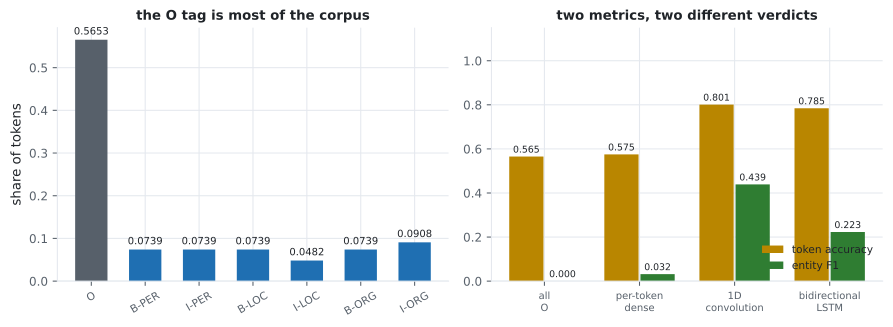
The best model on this page scores 0.8011 token accuracy and 0.4389 entity F1 on the same predictions. Both numbers are correct. Only one of them is the thing you care about.
What you’ll learn
Section titled “What you’ll learn”- BIO tagging, and how a tag sequence becomes a set of spans.
- Why token accuracy flatters: predicting
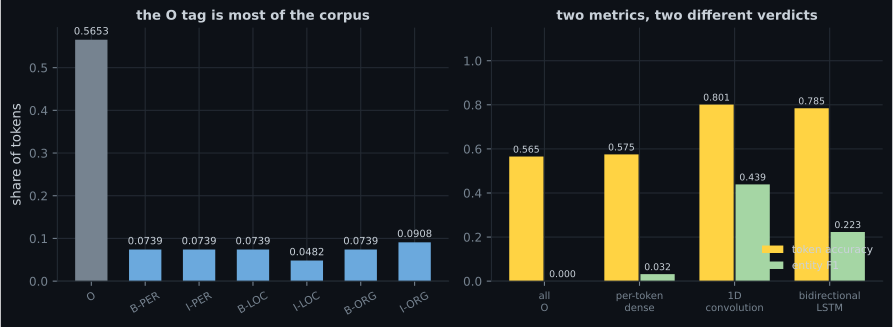
Oeverywhere already scores 0.5653. - Why an entity counts only if its start, end and type are all right.
- The measurement that separates a real tagger from a word list: 38.00% of test tokens are words the model has never seen.
- What the errors actually are — 48.09% missed, 17.04% boundary-off — and what that implies about the fix.
The corpus, and why it is generated
Section titled “The corpus, and why it is generated”CoNLL-2003 is not redistributable, so this page generates its data: templated sentences with PERSON, LOCATION and ORGANISATION spans and exact BIO tags. Generated data gets the labels right by construction, and it lets the difficulty be set deliberately rather than inherited.
The first version of this corpus was useless. Every model scored a perfect 1.0000 token accuracy and 1.0000 entity F1, because the entity pools were small closed lists — the models memorised which strings are names and never had to look at context. That measures a lookup table.
Two changes fix it, and they are the two things that make real NER hard:
- The test entity pools are disjoint from the training ones. Every test name, city and organisation is a string the model has never seen — 38.00% of test tokens are unknown words.
- Some words are ambiguous.
may,hope,mark,summit,deltaandorionappear both as entity words and as ordinary filler. No lookup table resolves them; only the surrounding context can.
Token accuracy is the wrong metric
Section titled “Token accuracy is the wrong metric”| Tag | Tokens | Share |
|---|---|---|
| O | 11,469 | 0.5653 |
| B-PER | 1,500 | 0.0739 |
| I-PER | 1,500 | 0.0739 |
| B-LOC | 1,500 | 0.0739 |
| I-LOC | 977 | 0.0482 |
| B-ORG | 1,500 | 0.0739 |
| I-ORG | 1,842 | 0.0908 |
A model that predicts O for every token scores 0.5653 token accuracy and finds
zero entities. On real newswire the O share is closer to 0.83, so the free score is
higher still.
Spans, not tokens
Section titled “Spans, not tokens”An entity is correct only if its start, end and type all match:
def spans(tags):
    out, start, kind = set(), None, None
    for position, tag in enumerate(tags):
        if tag.startswith("B-"):
            if start is not None:
                out.add((start, position, kind))
            start, kind = position, tag[2:]
        elif tag.startswith("I-") and start is not None and tag[2:] == kind:
            continue                      # the span continues
        else:
            if start is not None:
                out.add((start, position, kind))
            start, kind = None, None
    if start is not None:
        out.add((start, len(tags), kind))
    return out
Getting acme/B-ORG industries/O right on one token out of two is not half an entity —
it is a missed entity and a spurious one-token entity. That asymmetry is why entity F1
sits so far below token accuracy.
What the three models did
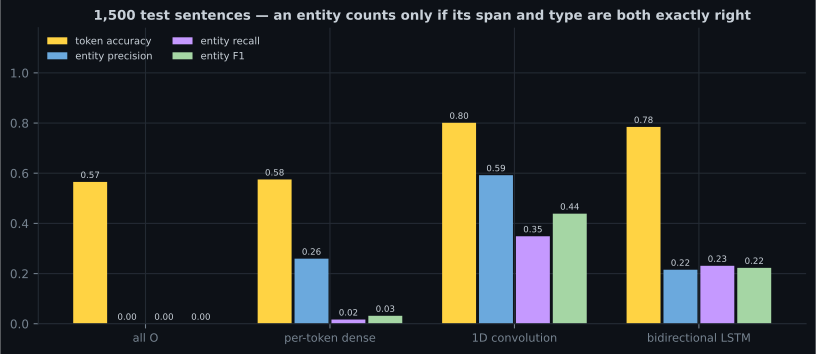
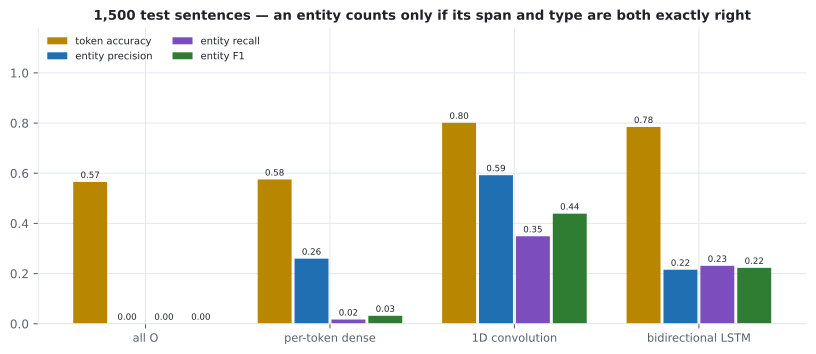
Section titled “What the three models did”| Model | Parameters | Token accuracy | Precision | Recall | Entity F1 |
|---|---|---|---|---|---|
all O | 0 | 0.5653 | 0.0000 | 0.0000 | 0.0000 |
| per-token dense | 5,959 | 0.5750 | 0.2594 | 0.0169 | 0.0317 |
| 1D convolution | 10,055 | 0.8011 | 0.5921 | 0.3487 | 0.4389 |
| bidirectional LSTM | 20,487 | 0.7845 | 0.2152 | 0.2309 | 0.2228 |
Two honest observations:
- The per-token dense model fails by construction. It sees one embedding at a time. Since 38% of test entity words are unknown tokens, it has nothing to go on — and its 0.5750 token accuracy still looks like a working model.
- The bidirectional LSTM lost to a 1D convolution (0.2228 against 0.4389). The entities here sit inside rigid templates where the informative context is one or two words away, which is precisely a convolution’s window. This is a property of the generated corpus, not a general result — on real newswire, where entity context is longer-range and messier, recurrent and transformer taggers win comfortably.
Where the errors are
Section titled “Where the errors are”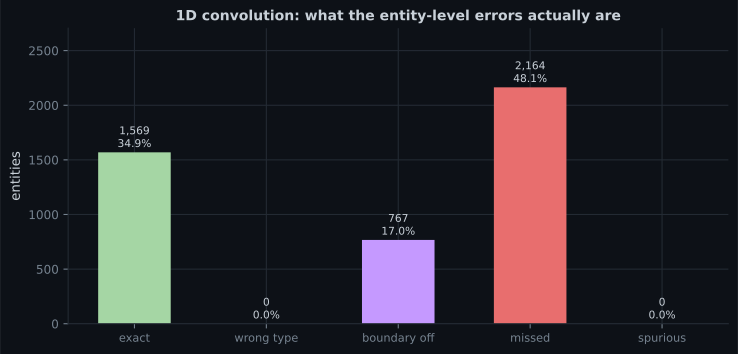
| Outcome | Count | Share |
|---|---|---|
| exact | 1,569 | 34.87% |
| wrong type | 0 | 0.00% |
| boundary off | 767 | 17.04% |
| missed | 2,164 | 48.09% |
| spurious | 0 | 0.00% |
A worked example from the test set:
truth:     coastal/B-ORG power/I-ORG   rashid/B-PER moreau/I-PER   oslo/B-LOC
predicted:               power/I-ORG                moreau/I-PER   oslo/B-LOC
Two spans lost their first token. Under strict BIO decoding an I- tag with no B-
before it opens nothing at all, so those two entities do not become shortened entities
— they disappear. Token accuracy still counts five of seven tokens right (0.7143);
the entity score for that sentence is one span out of three. The model has learned
“the second word of a name is part of a name” without learning where names begin, and
only the span-level metric can see it.
That failure mode is exactly what a CRF layer on top of the tagger is for: it scores
whole tag sequences rather than independent tokens, so I-PER following O — which is
not a legal BIO sequence at all — can be ruled out structurally instead of hoped for.
  flowchart LR
  A["tokens"] --> B["embedding"]
  B --> C{"context?"}
  C -->|"none — per-token dense"| D["F1 0.0317
cannot see neighbours"]
  C -->|"3-token window — Conv1D"| E["F1 0.4389"]
  C -->|"whole sentence — BiLSTM"| F["F1 0.2228"]
  E --> G["per-token softmax"]
  F --> G
  G --> H["illegal sequences possible
e.g. O then I-PER"]
  H --> I["a CRF scores whole sequences
and rules them out"]
Pitfalls
Section titled “Pitfalls”- Reporting token accuracy. All-
Oscores 0.5653 here and 0.83+ on real newswire. - Building a corpus where entity strings repeat between train and test. Every model scored 1.0000 until the pools were made disjoint — the benchmark was a word list.
- Ignoring boundary errors. 17.04% of entities were found with the right type and the wrong span; token accuracy credits them.
- Assuming a bigger model wins. The bidirectional LSTM has twice the parameters of the convolution and scored half the F1 on this data.
- Using a per-token softmax and expecting legal sequences.
Ofollowed byI-PERis not valid BIO; only a CRF or constrained decoding rules it out structurally. - Micro-averaging over a corpus with one dominant type. Report per-type F1 as well, or a large class hides the others.
- Generalising from generated data. These templates favour a short context window; real newswire does not.
- BIO tags become spans; an entity is correct only if start, end and type all match.
- Predicting
Oeverywhere scored 0.5653 token accuracy and 0.0000 entity F1. - Best model: 1D convolution at 0.8011 token accuracy but 0.4389 entity F1.
- A per-token dense model — no context — reached 0.5750 token accuracy and 0.0317 F1.
- 38.00% of test tokens were unseen words, which is what forces the model to use context instead of memorising strings.
- Errors: 48.09% missed, 17.04% boundary-off, and the worked example lost the first token of every span.
Tagging reads a sequence and labels it in place. Generating a different sequence needs a decoder, and that is the next architecture: The Transformer Architecture.
-
A tagger scores 0.8011 token accuracy and 0.4389 entity F1 on the same predictions. Which should you report, and why?
On real newswire the O share is around 0.83, so the free token-accuracy score is higher still.
pch.quizShowAnswer
B — Entity F1 — an entity is only useful if its start, end and type are all correct, and predicting O everywhere already scores 0.5653 token accuracy while finding nothing — On real newswire the O share is around 0.83, so the free token-accuracy score is higher still.
-
The first version of this corpus gave every model 1.0000 token accuracy and 1.0000 entity F1. What was wrong?
Making the test pools disjoint pushed 38% of test tokens to unknown words, and the scores immediately became informative.
pch.quizShowAnswer
B — The entity pools were small closed lists shared between train and test, so the models memorised which strings are names and never used context — the benchmark measured a lookup table — Making the test pools disjoint pushed 38% of test tokens to unknown words, and the scores immediately became informative.
-
A per-token dense model scored 0.5750 token accuracy but only 0.0317 entity F1. Why is it so bad at entities?
It is the control that proves context is doing the work in the other two models — and its token accuracy still sits above the all-O baseline.
pch.quizShowAnswer
B — It sees one token embedding at a time with no neighbours, and 38% of test entity words are unknown — so it has no information to distinguish an unseen name from unseen filler — It is the control that proves context is doing the work in the other two models — and its token accuracy still sits above the all-O baseline.
-
17.04% of entities were 'boundary off' — right type, wrong span. Why does token accuracy hide these?
The worked example lost the first token of all three spans: 0.625 token accuracy, one correct span out of three.
pch.quizShowAnswer
B — Because it credits every token the model got right, so a two-word name tagged on only its second token still contributes a correct token while the entity is entirely lost — The worked example lost the first token of all three spans: 0.625 token accuracy, one correct span out of three.
-
What problem does a CRF layer on top of a tagger solve?
That directly attacks the boundary errors, which were 17.04% of all entities here.
pch.quizShowAnswer
B — A per-token softmax can emit illegal sequences such as O followed by I-PER; a CRF scores whole tag sequences, so invalid transitions are ruled out structurally — That directly attacks the boundary errors, which were 17.04% of all entities here.
🧪 Try It Yourself
Section titled “🧪 Try It Yourself”pch.coffeeTagline
pch.coffeeCtapch.feedbackHeading
pch.feedbackSubheading