
Distributed Training with tf.distribute
Data parallelism is a three-line change: wrap the model construction in a strategy scope and keep everything else the same. What that change does to your batch size, your number of updates and therefore your effective learning rate is where the difficulty lives, and none of it requires a GPU to demonstrate.
What a strategy does to your batch
Section titled “What a strategy does to your batch”strategy = tf.distribute.MirroredStrategy()
with strategy.scope():
model = build_model() # variables created once per replica
model.compile(optimizer, loss, metrics=["accuracy"])
model.fit(x, y, batch_size=64 * strategy.num_replicas_in_sync)That last line is the part people miss. The batch_size you pass is the global batch: it is
split across replicas, so each one sees batch_size / num_replicas.
| Replicas | Global batch | Per replica | Gradient updates | Accuracy |
|---|---|---|---|---|
| 1 | 64 | 64 | 282 | 0.8813 |
| 2 | 128 | 64 | 141 | 0.8840 |
| 2 (batch not scaled) | 64 | 32 | 282 | 0.8813 |
Scaling the batch with the replica count keeps each device as busy as it was — but it halves the number of gradient updates for the same data. Two replicas processing 128 samples at a time take half as many steps through the epoch as one replica processing 64.
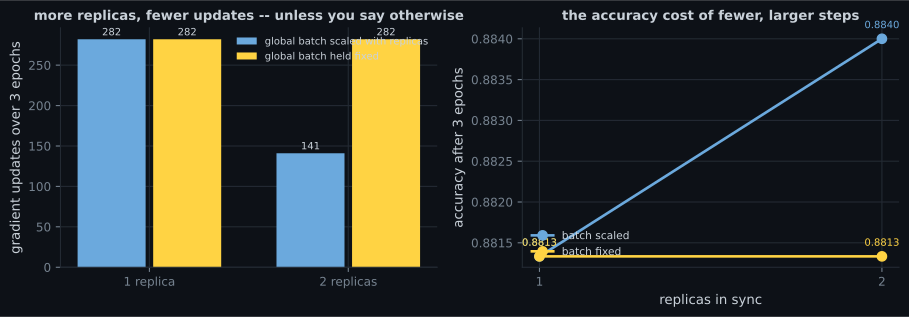
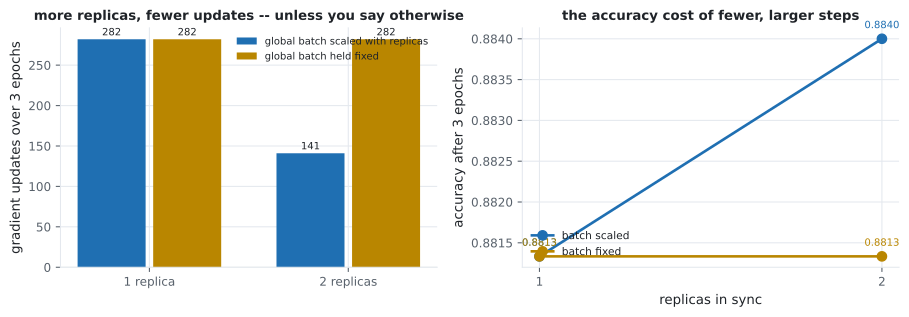
The standard remedy is the linear scaling rule: multiply the learning rate by the number of replicas, so that a step over a batch of 128 moves as far as two steps over batches of 64 would have. It is a heuristic, it needs a warm-up at large replica counts, and it stops working well past a few thousand samples per batch — but it is the right default.
The scaffolding is not free
Section titled “The scaffolding is not free”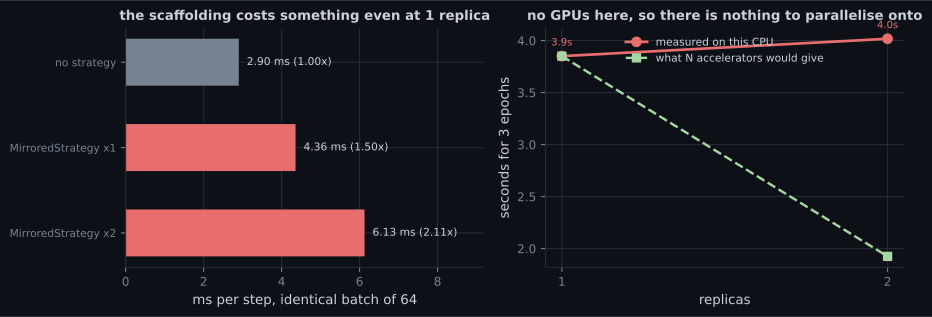
| Configuration | ms/step | Relative |
|---|---|---|
| No strategy | 2.90 | 1.00× |
MirroredStrategy ×1 | 4.36 | 1.50× |
MirroredStrategy ×2 | 6.13 | 2.11× |
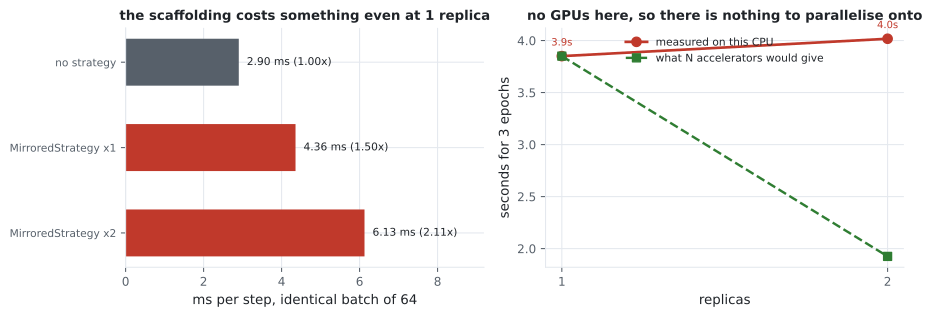
The one-replica row is the informative one. It does no distribution at all and still costs 50% more per step, because the strategy still places variables, still routes reads through mirrored copies, and still runs the all-reduce machinery over a single participant.
This is why distributing a small model is often slower than not distributing it, on any hardware: below some model size the per-step coordination outweighs what the extra devices contribute.
  flowchart TD
  B["global batch of 128"] --> S1["replica 1: 64 samples"]
  B --> S2["replica 2: 64 samples"]
  S1 --> G1["gradient 1"]
  S2 --> G2["gradient 2"]
  G1 --> AR["all-reduce: average"]
  G2 --> AR
  AR --> U["one update, applied to
both mirrored copies"]
  U -.->|"282 updates becomes 141"| L["scale the learning rate"]
  AR -.->|"equal shards: 2.2e-08 error
uneven shards: 1.8e-02"| E["shards must be equal"]
Is the averaged gradient the real gradient?
Section titled “Is the averaged gradient the real gradient?”Data parallelism rests on a claim that is easy to state and easy to check: the mean of the per-replica gradients equals the gradient of the whole batch. It is true, and only when the shards are the same size.
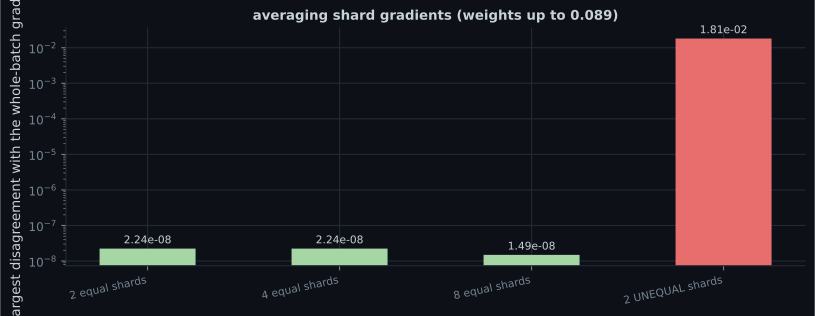
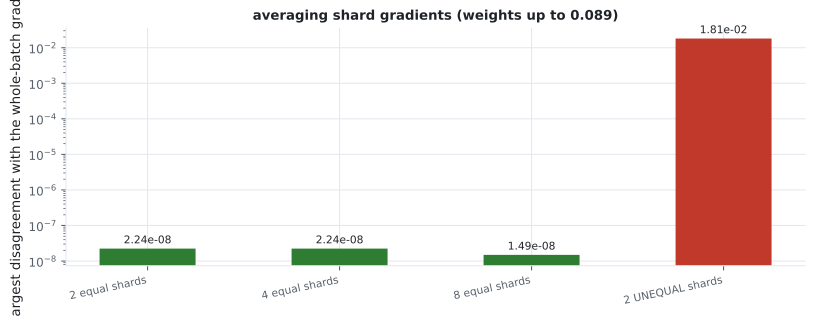
| Sharding | Max difference | Relative |
|---|---|---|
| 2 equal shards | 2.235e-08 | 2.505e-07 |
| 4 equal shards | 2.235e-08 | 2.505e-07 |
| 8 equal shards | 1.490e-08 | 1.670e-07 |
| 2 unequal shards | 1.812e-02 | 2.031e-01 |
This is the same bug as the per-batch metric averaging on the custom training loops page, wearing different clothes. Averaging means-of-means is only correct when the groups are equal, and in a distributed job the group that is different is usually the last batch of the epoch.
tf.distribute handles this for you — it drops or pads the remainder rather than averaging
unequal shards — but a hand-written distributed loop must do so explicitly, and a custom loss that
reduces with tf.reduce_mean inside a replica context has exactly this problem. The correct
pattern sums the per-example losses and divides by the global batch size:
per_example = keras.losses.sparse_categorical_crossentropy(labels, logits)
loss = tf.nn.compute_average_loss(per_example, global_batch_size=GLOBAL_BATCH)
Which strategy to reach for
Section titled “Which strategy to reach for”MirroredStrategy— several devices on one machine. Variables are mirrored, gradients all-reduced. This is the one measured above and the one most people need.MultiWorkerMirroredStrategy— the same idea across machines, coordinated by aTF_CONFIGenvironment variable. The failure modes become network failure modes.ParameterServerStrategy— asynchronous, with variables held on dedicated servers. Scales to many workers and gives up gradient synchrony to do it.TPUStrategy— for TPUs, where the batch must be divisible by the number of cores.
All four share the interface used above, which is the genuine achievement of the API: the training code does not change, only the scope it is built inside.
Pitfalls
Section titled “Pitfalls”- Forgetting the batch is global. Two replicas at
batch_size=64give each replica 32 samples, not 64. - Not scaling the learning rate. Two replicas halved the updates from 282 to 141; the same learning rate now travels half as far per epoch.
- Distributing a small model. One replica cost 1.50× per step and parallelised nothing.
- Building the model outside the scope. Variables must be created inside
strategy.scope()or they are not mirrored. - Averaging unequal shards. 20% relative error here; use
compute_average_losswith the global batch size. - Assuming more replicas is always faster. The coordination cost is per step and does not shrink as you add devices.
- Measuring speed-up on virtual CPU devices. They share the same cores; only semantics and overhead are measurable that way.
- The
batch_sizepassed tofitis the global batch, split across replicas. - Scaling it with the replica count halved the gradient updates, 282 → 141, which is why the learning rate is conventionally scaled too.
MirroredStrategycost 1.50× per step at one replica and 2.11× at two, before any parallelism.- Averaging equal shards reproduces the whole-batch gradient to 2.2e-08; unequal shards are wrong by 20%.
- Reduce losses with
compute_average_loss(..., global_batch_size=...)rather thanreduce_mean. - The four strategies share one interface; the training code does not change, only the scope.
Training is finished. The remaining question is how anything else reaches the model: Serving Models with TensorFlow Serving.
-
With two replicas and the global batch scaled to 128, the number of gradient updates fell from 282 to 141. Why does that matter?
Accuracy barely moved here (0.8840 against 0.8813) because three epochs on MNIST is forgiving, but on an update-limited job this is the difference between converging and not.
pch.quizShowAnswer
B — The same data is seen but the parameters are updated half as often, so at an unchanged learning rate the model travels half as far per epoch — which is why the linear scaling rule exists — Accuracy barely moved here (0.8840 against 0.8813) because three epochs on MNIST is forgiving, but on an update-limited job this is the difference between converging and not.
-
MirroredStrategy with ONE replica cost 1.50x per step against no strategy at all. What is that overhead?
It is why distributing a small model can be slower than not distributing it: below some size the per-step coordination outweighs what extra devices contribute.
pch.quizShowAnswer
B — Real scaffolding — variable placement, reads routed through mirrored copies, and the all-reduce machinery running over a single participant — It is why distributing a small model can be slower than not distributing it: below some size the per-step coordination outweighs what extra devices contribute.
-
Averaging gradients over equal shards matched the whole-batch gradient to 2.2e-08, but two unequal shards were wrong by 1.8e-02. What causes that?
It is the same bug as averaging per-batch accuracies, and in a distributed job the odd-sized group is usually the last batch of the epoch.
pch.quizShowAnswer
B — Averaging per-shard means weights each shard equally regardless of how many samples it holds, so a 56-sample shard counts as heavily as a 200-sample one — It is the same bug as averaging per-batch accuracies, and in a distributed job the odd-sized group is usually the last batch of the epoch.
-
Why must the model be constructed inside strategy.scope()?
The training call itself stays unchanged, which is the point of the API: only the construction scope differs.
pch.quizShowAnswer
B — Because that is where variables get created as mirrored copies — build outside the scope and you have ordinary variables that the strategy cannot keep in sync — The training call itself stays unchanged, which is the point of the API: only the construction scope differs.
-
How should a custom loss be reduced inside a replica context?
tf.distribute handles the built-in path by dropping or padding the remainder, but a hand-written reduction has to be explicit about the denominator.
pch.quizShowAnswer
B — With tf.nn.compute_average_loss and the GLOBAL batch size — reduce_mean divides by the per-replica count, which reintroduces the unequal-shard weighting — tf.distribute handles the built-in path by dropping or padding the remainder, but a hand-written reduction has to be explicit about the denominator.
🧪 Try It Yourself
Section titled “🧪 Try It Yourself”pch.coffeeTagline
pch.coffeeCtapch.feedbackHeading
pch.feedbackSubheading