
K-Fold Cross-Validation
What you’ll learn
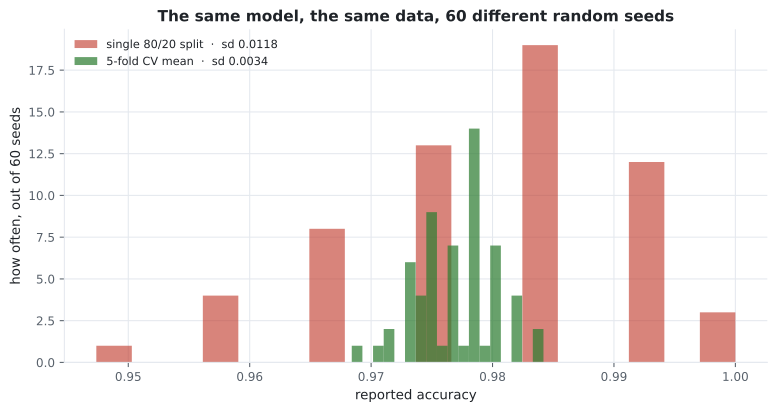
Section titled “What you’ll learn”- how much a reported score moves purely by changing the random seed — measured
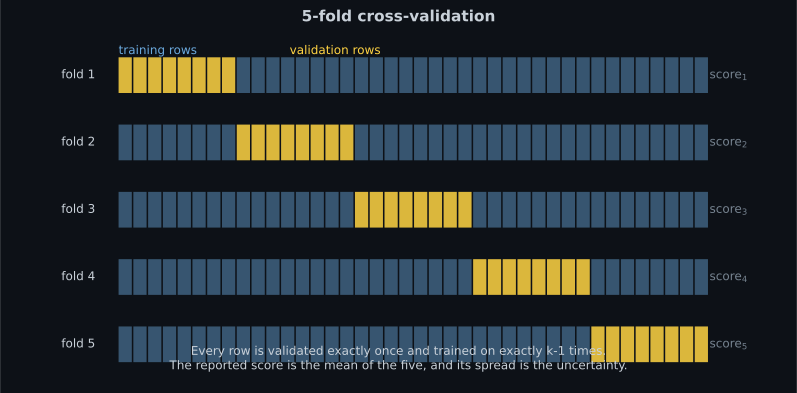
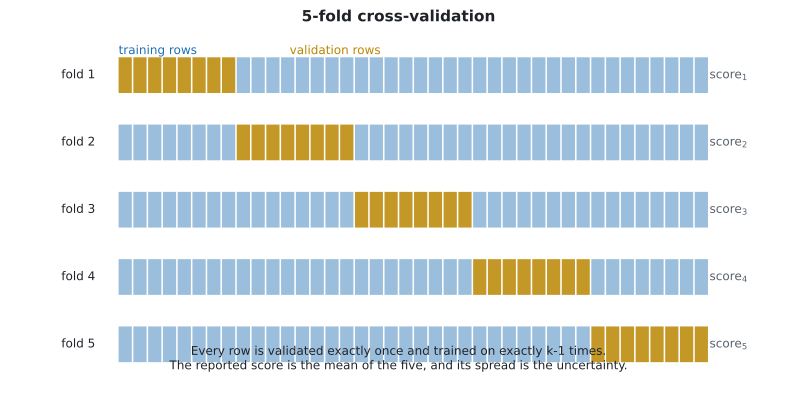
- the k-fold procedure, and why every row is validated exactly once
- how to choose , with the bias-variance argument behind the usual answer of 5 or 10
- the standard deviation across folds, which is the number people forget to report
- four splitters — plain, stratified, grouped and time-series — and when each is mandatory
cross_validatefor several metrics and train scores in one pass
Intuition
Section titled “Intuition”You split 80/20, train, score, and report 0.9737.
Change random_state from 0 to 1 and rerun. Now it is 0.9561. Neither number is wrong; both are
measurements of the same model on different samples of the same data. Reporting either alone
presents a coin flip as a fact.
Cross-validation replaces one measurement with of them, each on a different fifth of the data, and reports the mean. It also gives you something a single split never can: a spread, which is how you know whether a difference between two models is real.
How much does a single split move?
Section titled “How much does a single split move?”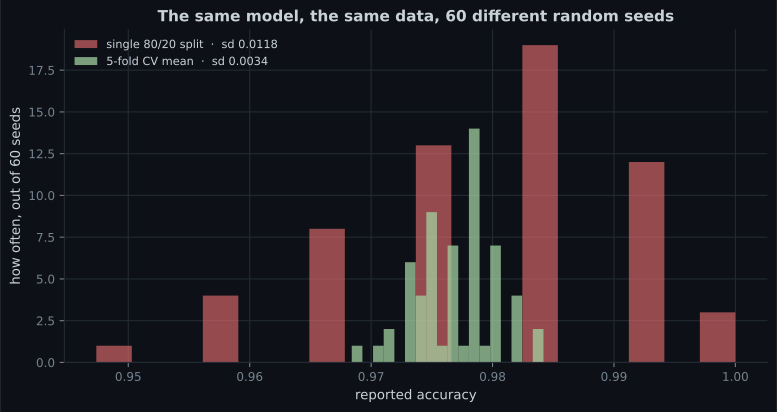
| Mean | Std dev | Observed range | |
|---|---|---|---|
| Single 80/20 split | 0.9785 | 0.0118 | 0.9474 – 1.0000 |
| 5-fold CV mean | 0.9773 | 0.0034 | 0.9684 – 0.9842 |
Reading the plot
Section titled “Reading the plot”- The single split reaches 1.0000 on some seeds. Perfect accuracy, from a model that averages 0.978. Pick that seed and report it and you are not lying, exactly — but nobody could reproduce it.
- The spread is 5.3 points wide. Two models differing by 2 points cannot be distinguished on a single split of this dataset.
- CV reduces the standard deviation by 3.5×. Not by being cleverer, but by averaging five measurements instead of taking one — the same that governs any mean.
- The means agree (0.9785 against 0.9773). CV is not more optimistic or more pessimistic; it is more precise.
The math
Section titled “The math”Given fold scores :
Report both. “0.85 ± 0.07” and “0.85 ± 0.005” describe very different situations, and only the first tells you a rival at 0.87 might be noise.
Choosing k
Section titled “Choosing k”trades three things against each other:
| Training set per fold | Bias of the estimate | Variance of the estimate | Cost | |
|---|---|---|---|---|
| 2 | 50% | High — trained on half the data | Low | 2 fits |
| 5 | 80% | Small | Moderate | 5 fits |
| 10 | 90% | Smaller | Moderate | 10 fits |
| (leave-one-out) | Almost none | High | fits |
Small means each model trains on less data, so it underperforms the model you will actually ship — a pessimistic bias. Large removes that bias, but the training sets then overlap almost completely, so their scores are highly correlated and averaging them removes less noise than you would expect.
Leave-one-out is the surprise. It sounds like the gold standard and is usually a poor choice: fits, and nearly identical models, so the variance of the estimate stays high. Use it only when is tiny.
5 or 10 is the answer for almost everything, and 5 is fine.
Worked example by hand
Section titled “Worked example by hand”Five fold scores from a classifier:
Step 1 — the mean.
Step 2 — the deviations and their squares.
| fold | |||
|---|---|---|---|
| 1 | 0.80 | −0.05 | 0.0025 |
| 2 | 0.90 | +0.05 | 0.0025 |
| 3 | 0.85 | 0.00 | 0.0000 |
| 4 | 0.95 | +0.10 | 0.0100 |
| 5 | 0.75 | −0.10 | 0.0100 |
| 0.00 | 0.0250 |
Step 3 — the standard deviation.
Step 4 — report it. .
Step 5 — read it. The folds range from 0.75 to 0.95, a 20-point swing on the same model. A rival model scoring 0.87 is not better on this evidence. If you need to distinguish models at that resolution, you need more data or more folds — not a bolder claim.
In code
Section titled “In code”from sklearn.datasets import load_breast_cancer
from sklearn.linear_model import LogisticRegression
from sklearn.model_selection import cross_val_score
from sklearn.pipeline import make_pipeline
from sklearn.preprocessing import StandardScaler
X, y = load_breast_cancer(return_X_y=True)
# The pipeline matters: the scaler is refitted inside each fold
model = make_pipeline(StandardScaler(), LogisticRegression(max_iter=5000))
scores = cross_val_score(model, X, y, cv=5)
print(scores.round(4)) # one score per fold
print(f"{scores.mean():.4f} +/- {scores.std():.4f}")Several metrics, and train scores, in one pass
Section titled “Several metrics, and train scores, in one pass”from sklearn.model_selection import cross_validate
results = cross_validate(
model, X, y, cv=5,
scoring=["accuracy", "precision", "recall", "roc_auc"],
return_train_score=True,
)
for name in ("accuracy", "precision", "recall", "roc_auc"):
train = results[f"train_{name}"].mean()
test = results[f"test_{name}"].mean()
print(f"{name:<10} train {train:.4f} test {test:.4f} gap {train - test:+.4f}")
# accuracy train 0.9895 test 0.9807 gap +0.0088
# precision train 0.9862 test 0.9782 gap +0.0080
# recall train 0.9972 test 0.9916 gap +0.0056
# roc_auc train 0.9977 test 0.9952 gap +0.0025return_train_score=True gives you the overfitting diagnosis from
Underfitting vs Overfitting
for free, on every metric, in the same call. Gaps under 0.01 here — a well-behaved model.
See it move
Section titled “See it move”The validation block rotates through the dataset. Each pass produces one score; the running mean and spread build up on the right.
Four splitters
Section titled “Four splitters”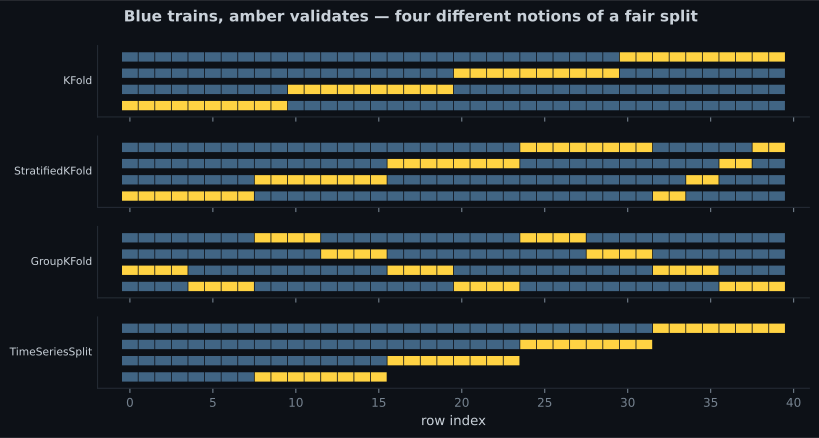
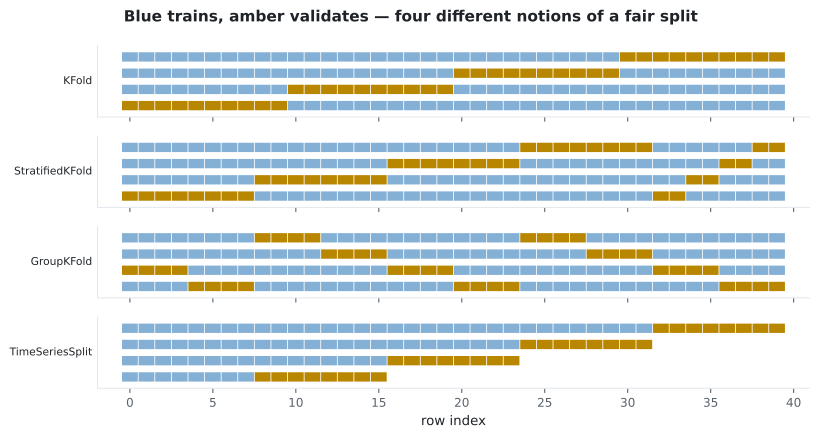
| Splitter | Guarantees | Mandatory when |
|---|---|---|
KFold | Every row validated once | The default, for i.i.d. data |
StratifiedKFold | Class ratio preserved per fold | Any classification, especially imbalanced |
GroupKFold | A group never spans folds | Repeated measures — patients, users, devices |
TimeSeriesSplit | Training always precedes validation | Any temporal ordering |
Choosing between them is mechanical once you know what your rows are:
  flowchart TD
  A["What is one row?"] --> B{"Do rows have
a time order that
matters?"}
  B -->|"yes -- events, readings,
transactions"| C["TimeSeriesSplit"]
  C --> C2["Folds are not comparable:
fold 0 trains on 4 rows,
fold 3 on 16."]
  B -->|"no"| D{"Can several rows
belong to the same
entity?"}
  D -->|"yes -- patients, users,
devices, documents"| E["GroupKFold
(or StratifiedGroupKFold)"]
  E --> E2["A group on both sides
lets the model recognise
the entity, not the pattern."]
  D -->|"no, rows are independent"| F{"Classification?"}
  F -->|"yes"| G["StratifiedKFold
shuffle=True"]
  F -->|"no, regression"| H{"Is the row order
meaningful in the file?"}
  H -->|"could be -- sorted by
date, region, id"| I["KFold shuffle=True,
fixed random_state"]
  H -->|"definitely not"| J["KFold, the default"]
  G --> K["Repeat with several seeds
if the fold spread is wide."]
  I --> K
  J --> K
Two of those branches are guards against leakage rather than preferences, which is why the table calls them mandatory: a group spanning folds and a future row in the training set both produce a score that is higher than the truth and gives no warning.
Time series
Section titled “Time series”A random split lets the model train on Thursday to predict Tuesday. The score is excellent and entirely meaningless.
from sklearn.model_selection import TimeSeriesSplit

splitter = TimeSeriesSplit(n_splits=4)
for i, (train_idx, val_idx) in enumerate(splitter.split(range(20))):
    print(f"fold {i}: train {train_idx.min()}-{train_idx.max()}"
          f"   validate {val_idx.min()}-{val_idx.max()}")

# fold 0: train 0-3    validate 4-7
# fold 1: train 0-7    validate 8-11
# fold 2: train 0-11   validate 12-15
# fold 3: train 0-15   validate 16-19
The training window grows and validation always sits immediately after it. Note the consequence: fold 0 trains on 4 rows and fold 3 on 16, so the folds are not comparable to each other. That is the price of respecting time.
Groups
Section titled “Groups”One row per hospital visit, several visits per patient. A random split puts the same patient on both sides, the model recognises the patient rather than the condition, and the score is inflated.
import numpy as np
from sklearn.model_selection import GroupKFold, cross_val_score

groups = np.repeat(np.arange(100), 5)      # 100 patients, 5 visits each

naive = cross_val_score(model, X_visits, y_visits, cv=5).mean()
honest = cross_val_score(model, X_visits, y_visits,
                         cv=GroupKFold(5), groups=groups).mean()

print(f"random split: {naive:.4f}")        # optimistic
print(f"group split:  {honest:.4f}")       # the number that transfers
Pitfalls
Section titled “Pitfalls”-
On this dataset a single 80/20 split reports between 0.9474 and 1.0000 depending on the seed. What does that imply?
The model is fine; the measurement is noisy. Averaging five folds cuts that noise by 3.5 times and yields a number that reproduces.
pch.quizShowAnswer
B — A single split cannot distinguish two models differing by less than about 5 points, so its score should never be reported alone — The model is fine; the measurement is noisy. Averaging five folds cuts that noise by 3.5 times and yields a number that reproduces.
-
Why is leave-one-out cross-validation usually a poor choice despite its low bias?
Low bias, high variance, high cost. Five or ten folds give a better estimate for a fraction of the compute.
pch.quizShowAnswer
B — The n training sets overlap almost completely, so the n scores are highly correlated and averaging them removes little noise — at n times the cost — Low bias, high variance, high cost. Five or ten folds give a better estimate for a fraction of the compute.
-
You have several rows per patient. Which splitter do you need?
Without grouping, a patient's other visits sit in the training set and the model can identify the patient rather than learn the condition. GroupKFold keeps every patient wholly on one side.
pch.quizShowAnswer
C — GroupKFold with patient as the group — Without grouping, a patient's other visits sit in the training set and the model can identify the patient rather than learn the condition. GroupKFold keeps every patient wholly on one side.
-
Your five folds score 0.80, 0.90, 0.85, 0.95 and 0.75. A rival model reports 0.87. What can you conclude?
0.850 ± 0.071 comfortably contains 0.87. Distinguishing models at that resolution needs more data or more folds, not a bolder claim.
pch.quizShowAnswer
B — Nothing — your own folds span 20 points with a standard deviation of 0.071, so 0.87 is well inside the noise — 0.850 ± 0.071 comfortably contains 0.87. Distinguishing models at that resolution needs more data or more folds, not a bolder claim.
🧪 Try It Yourself
Section titled “🧪 Try It Yourself”Exercise 1 – Mean and spread by hand
Section titled “Exercise 1 – Mean and spread by hand”Exercise 2 – Run 5-fold cross-validation
Section titled “Exercise 2 – Run 5-fold cross-validation”Exercise 3 – Measure the noise a single split adds
Section titled “Exercise 3 – Measure the noise a single split adds”Exercise 4 – Several metrics in one pass
Section titled “Exercise 4 – Several metrics in one pass”Exercise 5 – Respect the arrow of time
Section titled “Exercise 5 – Respect the arrow of time”- A single 80/20 split on this dataset reports anywhere from 0.9474 to 1.0000 across seeds. The 5-fold mean spans 0.9684 to 0.9842, with 3.5 times less spread.
- Every row is validated exactly once; you get scores, a mean and a standard deviation.
- Report both. and demand different conclusions.
- or 10. Leave-one-out is expensive and, because its training sets overlap almost entirely, higher-variance than it sounds.
- Four splitters: plain, stratified (any classification), grouped (repeated measures), time-series
(anything temporal).
cv=5does not shuffle. cross_validatereturns several metrics plus train scores in one pass.- Always pass the pipeline, never a pre-transformed matrix.
Exercise 6 – What does raising the fold count buy?
Section titled “Exercise 6 – What does raising the fold count buy?”Continue to Hyperparameter Tuning with GridSearchCV — use this machinery not just to measure a model but to choose between hundreds of them.
pch.coffeeTagline
pch.coffeeCtapch.feedbackHeading
pch.feedbackSubheading