
Transformation Pipelines & Custom Transformers
What you’ll learn
Section titled “What you’ll learn”- what goes wrong when preprocessing is a sequence of loose steps
PipelineandColumnTransformer, and the one rule that makes them leak-proof- how to write a transformer scikit-learn will accept, in about fifteen lines
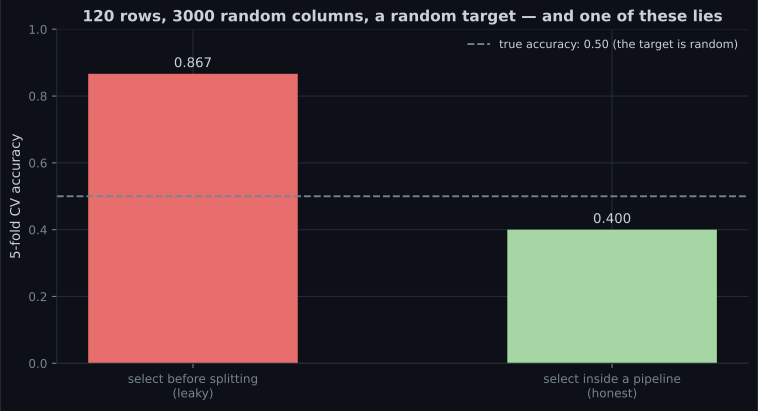
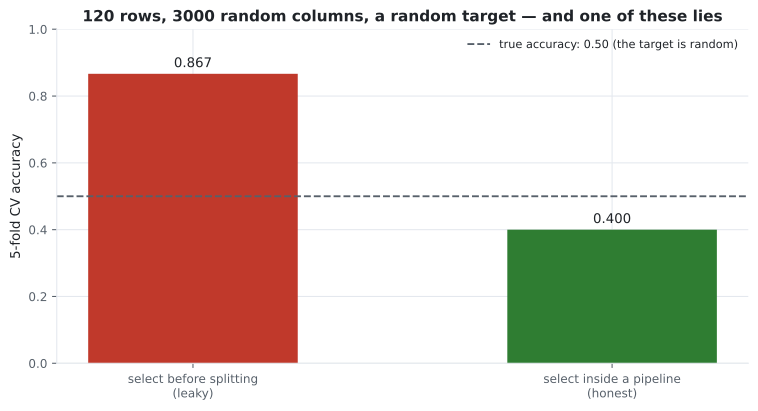
- leakage demonstrated: 0.867 accuracy from a dataset with no signal in it at all
- the leaky-scaler arithmetic, computed by hand
- how
fitandtransformpropagate through a nested pipeline
Intuition
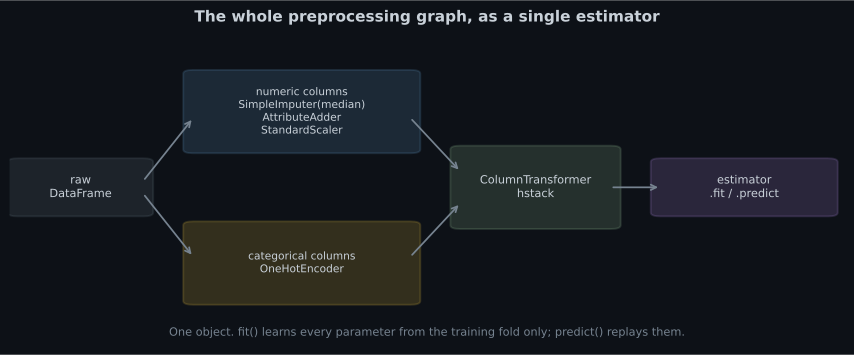
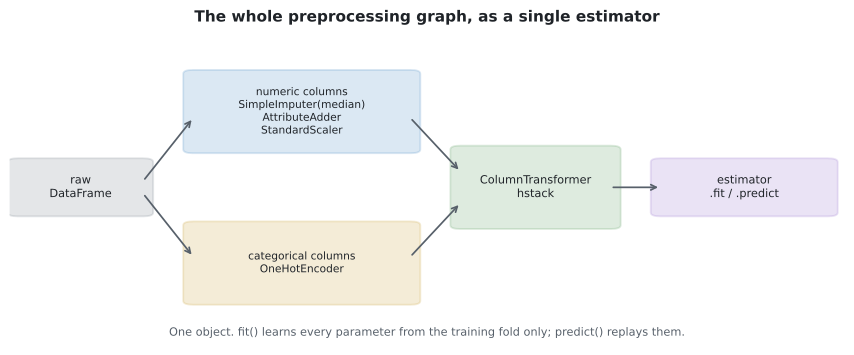
Section titled “Intuition”By now the preprocessing is: impute the medians, add three ratio columns, one-hot the categorical column, scale the numeric ones. Four steps, each with learned parameters — nine medians, five category names, nine means and nine standard deviations.
Done by hand, every one of those has to be recreated identically for the test set, for every cross-validation fold, and for every live request. Miss one and the model receives inputs that do not match what it was trained on. Recompute one on the wrong data and you have leaked.
A Pipeline makes that structural. The whole graph becomes a single estimator with one fit and
one transform, and the parameters are learned exactly once, from exactly the right rows.
The problem with loose steps
Section titled “The problem with loose steps”# Every one of these has to be repeated, identically, for the test set
imputer = SimpleImputer(strategy="median").fit(X_train_num)
X_train_num_imp = imputer.transform(X_train_num)
X_train_num_imp = add_ratio_features(X_train_num_imp)
scaler = StandardScaler().fit(X_train_num_imp)
X_train_num_scaled = scaler.transform(X_train_num_imp)
encoder = OneHotEncoder(handle_unknown="ignore").fit(X_train_cat)
X_train_cat_enc = encoder.transform(X_train_cat)
X_train_prepared = np.hstack([X_train_num_scaled, X_train_cat_enc.toarray()])
# ... and now all of it again for X_test, in the same order, with the same objectsFour fitted objects to keep in sync, one hard-coded column order, and no way to cross-validate the
whole thing — because cross_val_score would need to redo the preprocessing inside each fold, and
it cannot reach into this code.
Pipeline
Section titled “Pipeline”from sklearn.impute import SimpleImputer
from sklearn.pipeline import Pipeline
from sklearn.preprocessing import StandardScaler
num_pipeline = Pipeline([
("imputer", SimpleImputer(strategy="median")),
("attribs", AttributeAdder()),
("scaler", StandardScaler()),
])
X_train_num_prepared = num_pipeline.fit_transform(X_train_num)
X_test_num_prepared = num_pipeline.transform(X_test_num) # transform onlyThe contract: every step except the last must be a transformer (fit and transform); the
last may be a transformer or a predictor. Calling fit runs fit_transform down the chain and
fit on the final step. Calling transform or predict runs transform down the chain.
Access the fitted pieces by name — num_pipeline.named_steps["imputer"].statistics_ — or by
position, num_pipeline[0].
A custom transformer
Section titled “A custom transformer”Any class with fit and transform works. Inheriting from BaseEstimator and TransformerMixin
adds get_params / set_params (so GridSearchCV can tune it) and fit_transform (so you do not
write it yourself):
import numpy as np
from sklearn.base import BaseEstimator, TransformerMixin

ROOMS, BEDROOMS, POPULATION, HOUSEHOLDS = 3, 4, 5, 6      # column indices


class AttributeAdder(BaseEstimator, TransformerMixin):
    """Add the three ratio features found during exploration."""

    def __init__(self, add_bedrooms_per_room=True):
        # No validation and no *args/**kwargs here — get_params relies on
        # every constructor argument being stored under its own name.
        self.add_bedrooms_per_room = add_bedrooms_per_room

    def fit(self, X, y=None):
        return self          # nothing to learn; still required by the API

    def transform(self, X):
        rooms_per_household = X[:, ROOMS] / X[:, HOUSEHOLDS]
        population_per_household = X[:, POPULATION] / X[:, HOUSEHOLDS]
        if self.add_bedrooms_per_room:
            bedrooms_per_room = X[:, BEDROOMS] / X[:, ROOMS]
            return np.c_[X, rooms_per_household, population_per_household,
                         bedrooms_per_room]
        return np.c_[X, rooms_per_household, population_per_household]


adder = AttributeAdder(add_bedrooms_per_room=False)
print(adder.get_params())     # {'add_bedrooms_per_room': False}
Because add_bedrooms_per_room is a proper hyperparameter, a grid search can decide whether the
feature helps:
GridSearchCV(full_pipeline, {"preparation__num__attribs__add_bedrooms_per_room": [True, False]})For stateless transformations, FunctionTransformer skips the class entirely:
from sklearn.preprocessing import FunctionTransformer
log_transformer = FunctionTransformer(np.log1p, inverse_func=np.expm1, validate=True)
ColumnTransformer
Section titled “ColumnTransformer”Numeric and categorical columns need different treatment, and ColumnTransformer routes them:
from sklearn.compose import ColumnTransformer
from sklearn.preprocessing import OneHotEncoder

num_attribs = list(housing_num.columns)          # 9 numeric columns
cat_attribs = ["ocean_proximity"]

full_preparation = ColumnTransformer([
    ("num", num_pipeline, num_attribs),
    ("cat", OneHotEncoder(handle_unknown="ignore"), cat_attribs),
])

housing_prepared = full_preparation.fit_transform(housing)
print(housing_prepared.shape)      # (16512, 17)  = 9 + 3 ratios + 5 categories
Each tuple is (name, transformer, columns). Anything not listed is dropped by default;
remainder="passthrough" keeps it instead. Output columns appear in the order the transformers are
listed.
The routing is easier to see than to read:
  flowchart LR
  RAW["housing DataFrame
16,512 rows x 10 columns"] --> CT{{"ColumnTransformer"}}
  CT -->|"num: 9 numeric columns"| NP["num_pipeline"]
  CT -->|"cat: ocean_proximity"| OH["OneHotEncoder
handle_unknown='ignore'"]
  CT -.->|"not listed"| DROP["dropped
unless remainder='passthrough'"]
  NP --> S1["SimpleImputer
strategy='median'"]
  S1 --> S2["CombinedAttributesAdder
+3 ratio columns"]
  S2 --> S3["StandardScaler"]
  S3 --> OUT1["12 numeric columns"]
  OH --> OUT2["5 indicator columns"]
  OUT1 --> CAT["hstack in the order
the transformers were listed"]
  OUT2 --> CAT
  CAT --> FINAL["housing_prepared
16,512 x 17"]
Two properties are worth naming. The numeric branch is itself a Pipeline, so nesting is the normal
case rather than a trick. And the final width is not something you choose — it is ,
determined by what each branch emits, which is why get_feature_names_out() exists.
Leakage, demonstrated
Section titled “Leakage, demonstrated”The argument for pipelines is not tidiness. It is that manual preprocessing leaks, and leakage is invisible in the metrics.
import numpy as np
from sklearn.feature_selection import SelectKBest, f_classif
from sklearn.linear_model import LogisticRegression
from sklearn.model_selection import cross_val_score
from sklearn.pipeline import make_pipeline

rng = np.random.default_rng(0)
X = rng.normal(size=(120, 3000))       # pure noise
y = rng.integers(0, 2, 120)            # unrelated to X

# WRONG — selection sees every row, including the ones held out later
leaked = SelectKBest(f_classif, k=20).fit_transform(X, y)
print(cross_val_score(LogisticRegression(max_iter=2000), leaked, y, cv=5).mean())
# 0.8667

# RIGHT — selection happens inside each fold
honest = make_pipeline(SelectKBest(f_classif, k=20), LogisticRegression(max_iter=2000))
print(cross_val_score(honest, X, y, cv=5).mean())
# 0.4000
Reading the plot
Section titled “Reading the plot”- There is no signal. Both
Xandyare random and independent, so any honest estimate must sit near 0.50. - The leaky version reports 0.867. With 3,000 random columns, 20 of them correlate with
yby chance across the whole dataset — including the validation rows. The model then “predicts” those rows using columns chosen because they matched them. - The honest version reports 0.400. Below 0.50, because with 120 rows and 24 per fold the estimate is noisy. That noise is the truth; the 0.867 is not.
- Nothing warns you. No error, no exception, no suspicious-looking output. On real data with real signal, leakage inflates a plausible 0.85 into a plausible 0.93, and you deploy it.
The general rule: any operation that learns from data must happen inside the cross-validation
loop. That includes scaling, imputation, feature selection, target encoding, PCA, and
oversampling. Pipeline is what puts them there.
See it move
Section titled “See it move”The sketch runs that same experiment live: pure-noise columns, a random target, five folds. Watch where the selector looks. On the left it is allowed to score every row before the split — including the fold that is about to be held out — and the accuracy it reports drifts upward as you give it more columns to choose from. On the right the selector is inside the fold, so more columns buy it nothing.
The red trace is not a bug in the classifier — it is a correct measurement of the wrong quantity. Give the selector 600 columns to sift and it will find four that happen to separate the held-out rows, because it was shown them.
The same procedure ported to NumPy and averaged over 40 random datasets, to check that the sketch is not a visual accident:
| Candidate columns | Selected before splitting | Selected inside each fold |
|---|---|---|
| 20 | 0.654 | 0.500 |
| 60 | 0.715 | 0.496 |
| 150 | 0.770 | 0.510 |
| 300 | 0.783 | 0.493 |
| 600 | 0.796 | 0.521 |
The honest column is flat at chance, as it must be on noise. The leaky column climbs monotonically with the number of candidates. The gap between the two is the size of the lie, and it widens in exactly the direction modern feature engineering pushes: more columns, more transformations, more chances for something to match the validation rows by accident.
Worked example by hand: the leaky scaler
Section titled “Worked example by hand: the leaky scaler”Training values and one test value .
Wrong — fit on everything. Mean of all four values is 26.5, population standard deviation 42.4411:
Right — fit on training only. Mean 2, standard deviation 0.8165:
The two are not slightly different, they are different in kind. Fitted on everything, the training data is squeezed into a span of 0.047 and the test point looks unremarkable at 1.73. Fitted correctly, the training data spans 2.45 and the test point is revealed for what it is: an extreme value 120 standard deviations out.
The leaky version does not merely produce a nicer number. It hides the fact that the test point is an outlier — which is exactly the information the model most needed.
The full pipeline
Section titled “The full pipeline”from sklearn.compose import ColumnTransformer
from sklearn.ensemble import RandomForestRegressor
from sklearn.impute import SimpleImputer
from sklearn.model_selection import cross_val_score
from sklearn.pipeline import Pipeline
from sklearn.preprocessing import OneHotEncoder, StandardScaler
num_pipeline = Pipeline([
("imputer", SimpleImputer(strategy="median")),
("attribs", AttributeAdder()),
("scaler", StandardScaler()),
])
preparation = ColumnTransformer([
("num", num_pipeline, num_attribs),
("cat", OneHotEncoder(handle_unknown="ignore"), cat_attribs),
])
full_pipeline = Pipeline([
("preparation", preparation),
("model", RandomForestRegressor(n_estimators=80, random_state=42, n_jobs=-1)),
])
# One call. Preprocessing is refitted inside every fold, automatically.
scores = -cross_val_score(full_pipeline, housing, housing_labels, cv=5,
scoring="neg_root_mean_squared_error")
print(f"RMSE {scores.mean():,.0f} (+/- {scores.std():,.0f})")
full_pipeline.fit(housing, housing_labels)
predictions = full_pipeline.predict(new_districts) # raw DataFrame in, prices outThree properties follow, and each one is the point:
- Cross-validation is honest. Every fold refits the imputer, the scaler and the encoder on that fold’s training rows only.
- Deployment is one object.
joblib.dump(full_pipeline, "model.pkl")saves the preprocessing with the model. There is no second script to keep in sync. - Tuning reaches everything.
GridSearchCVcan searchpreparation__num__imputer__strategyalongsidemodel__n_estimators, using the double-underscore path through the nesting.
Pitfalls
Section titled “Pitfalls”-
Feature selection on 3,000 random columns before cross-validation reported 0.867 accuracy on random labels. Why?
With 3,000 columns and 120 rows, chance correlations are guaranteed. Selecting on all the data lets validation rows influence which columns survive, and the score becomes self-fulfilling.
pch.quizShowAnswer
B — Some columns correlate with the target by chance across the whole dataset, including the validation rows — so the model is scored on rows that helped choose its features — With 3,000 columns and 120 rows, chance correlations are guaranteed. Selecting on all the data lets validation rows influence which columns survive, and the score becomes self-fulfilling.
-
What is the rule that makes a pipeline leak-proof?
Scaling, imputation, selection, encoding and PCA all learn from data. Fitted outside the loop, each one leaks; inside a Pipeline, cross_val_score refits them per fold automatically.
pch.quizShowAnswer
B — Any operation that learns parameters from data must run inside the cross-validation loop, which is exactly what Pipeline arranges — Scaling, imputation, selection, encoding and PCA all learn from data. Fitted outside the loop, each one leaks; inside a Pipeline, cross_val_score refits them per fold automatically.
-
Why must a custom transformer store its constructor arguments unchanged, under the same names?
BaseEstimator's get_params introspects __init__ and reads self.<argname>. If that attribute is missing or altered, clone() fails and every CV fold errors out.
pch.quizShowAnswer
B — Because get_params reads the constructor signature and looks up matching attributes — renaming or coercing them breaks cloning inside cross-validation and grid search — BaseEstimator's get_params introspects __init__ and reads self.<argname>. If that attribute is missing or altered, clone() fails and every CV fold errors out.
-
Scaling [1, 2, 3] and [100] together gives the training data a span of 0.047 and puts the test point at 1.73. Fitted on training only, the test point lands at 120. What is the real cost of the leaky version?
The leaky scaler absorbs the outlier into its own statistics, so the outlier stops looking like one. Honest scaling exposes it at 120 standard deviations out.
pch.quizShowAnswer
B — It hides that the test point is an extreme outlier — precisely the information the model needed — The leaky scaler absorbs the outlier into its own statistics, so the outlier stops looking like one. Honest scaling exposes it at 120 standard deviations out.
🧪 Try It Yourself
Section titled “🧪 Try It Yourself”Exercise 1 – Chain steps with Pipeline
Section titled “Exercise 1 – Chain steps with Pipeline”Exercise 2 – Write a custom transformer
Section titled “Exercise 2 – Write a custom transformer”Exercise 3 – Route columns with ColumnTransformer
Section titled “Exercise 3 – Route columns with ColumnTransformer”Exercise 4 – Manufacture accuracy from noise
Section titled “Exercise 4 – Manufacture accuracy from noise”Exercise 5 – The leaky scaler, by hand
Section titled “Exercise 5 – The leaky scaler, by hand”- Manual preprocessing means keeping several fitted objects in sync, and it cannot be cross-validated honestly.
Pipelinechains transformers into one estimator;ColumnTransformerroutes different columns to different treatments.- A custom transformer needs
fitreturningselfandtransform;BaseEstimatorandTransformerMixinsupply the rest — provided constructor arguments are stored unchanged. - Leakage demonstrated: 3,000 random columns, a random target, and selecting before splitting reports 0.867 against a true 0.50.
- The leaky-scaler example does more than distort a number: it hides the test outlier at 1.73 instead of exposing it at 120.
- Any operation that learns from data belongs inside the cross-validation loop.
Pipelineis the mechanism that puts it there.
Exercise 6 – Watch the lie grow with the number of columns
Section titled “Exercise 6 – Watch the lie grow with the number of columns”Continue to End-to-End Machine Learning Project (California Housing) — assemble everything in this phase, train three models, tune the winner and open the test set exactly once.
pch.coffeeTagline
pch.coffeeCtapch.feedbackHeading
pch.feedbackSubheading