
The Same Network in PyTorch
Every other page in this module is Keras. That is a deliberate choice — learning one framework properly beats learning two badly — but it leaves an obvious question unanswered: how much of what you have learned is about neural networks, and how much is about TensorFlow?
This page answers it by measurement. The same architecture is built in both frameworks, given byte-identical weights, and run on the same batch. Whatever differs is framework; whatever matches is the subject.
What you’ll learn
Section titled “What you’ll learn”- The line-by-line translation between
keras.Sequentialandtorch.nn.Sequential. - What
fit()hides, written out as the loop PyTorch makes you write yourself. - The measured agreement: gradients matching to 7.45e-09 on gradients of size 0.0386.
- Identical training producing identical accuracy, and where the wall clock differs.
- The differences that are real and easy to miss: initialisers,
epsilon, and bias.
The same model, twice
Section titled “The same model, twice”# Keras
model = keras.Sequential([
keras.layers.Input((784,)),
keras.layers.Dense(128, activation="relu"),
keras.layers.Dense(10),
])
# PyTorch
model = nn.Sequential(
nn.Linear(784, 128),
nn.ReLU(),
nn.Linear(128, 10),
)Both report 101,770 parameters. Three differences are visible immediately and all three are notation:
- Activations are layers in PyTorch. Keras folds
reluintoDenseas an argument;nn.Sequentialneedsnn.ReLU()as its own entry. There is no computational difference — Keras is applying exactly the same function after the matrix multiply. - PyTorch needs no
Input. Shapes are inferred when data first flows through, sonn.Linear(784, 128)states its input size directly rather than deriving it. - Weight matrices are transposed. Keras stores a
Densekernel as(in, out);torch.nn.Linearstores it as(out, in). Copying weights between them requires a.T, and forgetting it is the single most common way this comparison goes wrong — the shapes happen to be compatible whenin == out, so it fails silently on square layers.
Do they compute the same thing?
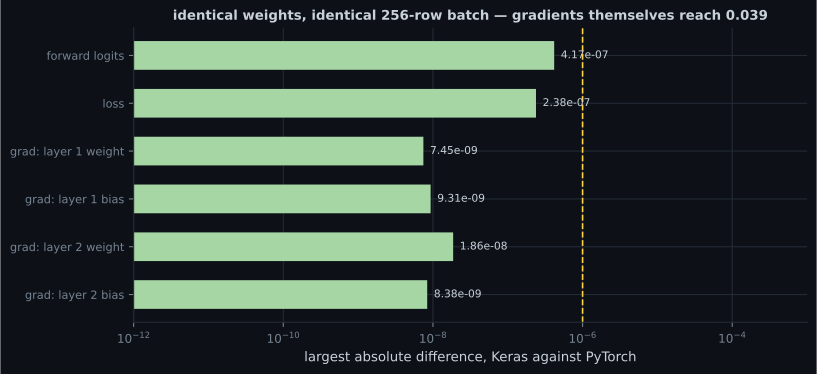
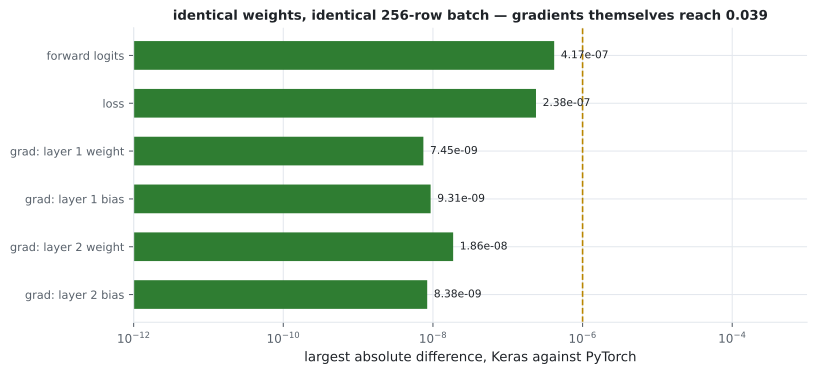
Section titled “Do they compute the same thing?”Give both models identical weights, push the same 256-row batch through, take the loss and one backward pass:
| Quantity | Largest absolute difference |
|---|---|
| Forward logits | 4.17e-07 |
| Loss | 2.38e-07 |
| Gradient: layer 1 weight | 7.45e-09 |
| Gradient: layer 1 bias | 9.31e-09 |
| Gradient: layer 2 weight | 1.86e-08 |
| Gradient: layer 2 bias | 8.38e-09 |
Read those against the scale of the thing being measured. The gradients reach 0.0386, so a disagreement of 7.45e-09 is roughly one part in five million — the two libraries are running the same arithmetic in a different order and float32 is rounding differently.
This is the page’s main result. Backpropagation, cross-entropy, ReLU and dense layers are not TensorFlow features. Everything Phase 1 taught transfers unchanged.
What fit() was doing
Section titled “What fit() was doing”The frameworks diverge sharply in what they hand you. Keras gives you fit(). PyTorch
gives you the loop:
# What Keras does for you, written out
optimiser = torch.optim.SGD(model.parameters(), lr=0.1)
for epoch in range(EPOCHS):
    for start in range(0, len(x), BATCH):
        batch_x = torch.tensor(x[start:start + BATCH])
        batch_y = torch.tensor(y[start:start + BATCH])
        optimiser.zero_grad()                                   # 1
        loss = F.cross_entropy(model(batch_x), batch_y)         # 2
        loss.backward()                                         # 3
        optimiser.step()                                        # 4
Four lines, and each one corresponds to something fit() does silently:
zero_grad()— PyTorch accumulates gradients into.grad, so they must be cleared. This is the same+=accumulation the autograd page builds by hand, and it is deliberate: it lets you sum gradients across several backward passes. Forget it and every step uses the sum of all previous gradients.- The forward pass and loss, identical in substance to Keras’s
compile(loss=...). backward()— walks the recorded graph.GradientTaperecords the same graph; the difference is that a tape is opened explicitly and PyTorch records always.step()— applies the update. Keras’sapply_gradients, spelled shorter.
Whether that is a cost or a benefit depends entirely on what you are doing, and the honest answer is that Phase 8’s custom training loops page has you writing the same four steps in TensorFlow the moment you need control.
  flowchart TD
  A["one architecture"] --> K["keras.Sequential
101,770 parameters"]
  A --> T["torch.nn.Sequential
101,770 parameters"]
  K --> W["identical weights
copied across, with a transpose"]
  T --> W
  W --> G["gradients agree to 7.45e-09
on gradients of size 0.0386"]
  G --> R["same maths"]
  K --> D["different defaults:
init spread, Adam epsilon, bias"]
  T --> D
  D --> S["different results
if you never set them"]
Training them side by side
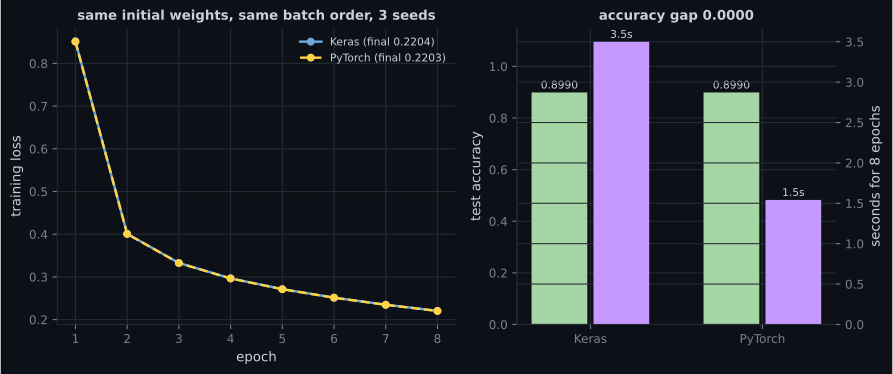
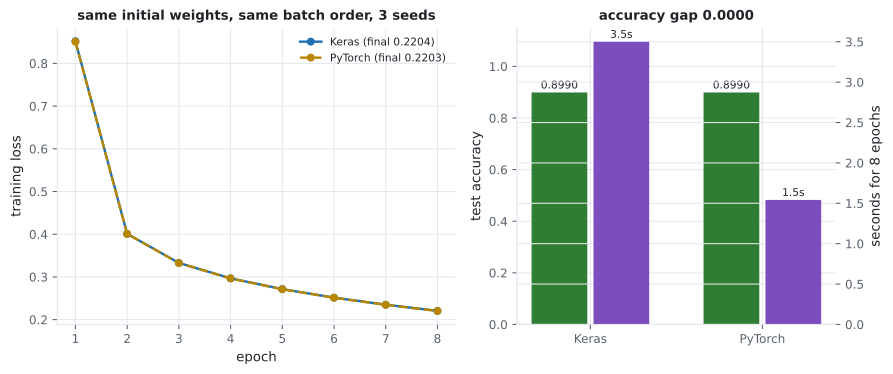
Section titled “Training them side by side”Same initial weights, same batch order, same optimiser and learning rate, eight epochs, three seeds:
| Keras | PyTorch | |
|---|---|---|
| Final training loss | 0.2204 | 0.2203 |
| Test accuracy | 0.8990 | 0.8990 |
| Spread across 3 seeds | 0.0040 | 0.0040 |
| Seconds for 8 epochs | 3.9 | 2.1 |
The accuracy gap is 0.0000. Do not over-read the timing: this is a 101,770-parameter
model on CPU, where per-step framework overhead dominates and PyTorch’s eager loop has
less of it than fit()’s callback and metric machinery. On a large model on a GPU the
comparison is different, and neither of those is available here to test it.
The differences that actually bite
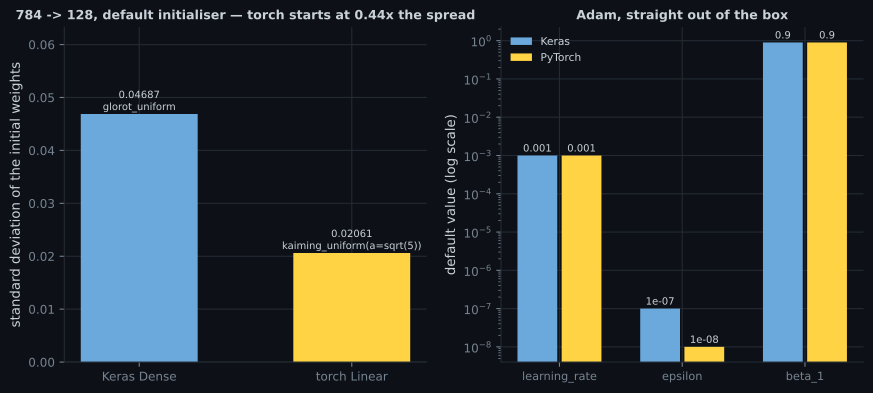
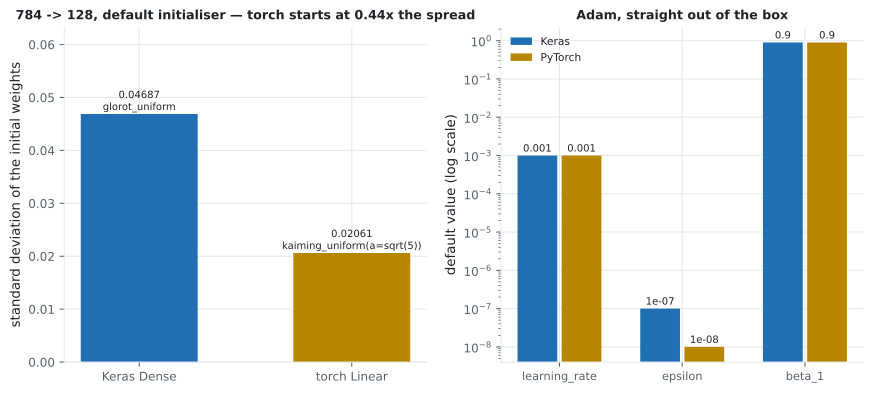
Section titled “The differences that actually bite”The mathematics matches. The defaults do not, and they are the reason two “identical” models can train differently when nobody has made a mistake.
| Default | Keras | PyTorch |
|---|---|---|
| Dense/Linear initialiser | glorot_uniform | kaiming_uniform(a=√5) |
| Initial weight sd (784 → 128) | 0.04687 | 0.02061 |
| Initial bias | all zeros | uniform, up to 0.03538 |
| Adam learning rate | 0.001 | 0.001 |
Adam beta_1 | 0.9 | 0.9 |
Adam epsilon | 1e-07 | 1e-08 |
Three things to take from that table.
The initialisers differ by 2.3×. Keras’s Glorot scales by fan-in and fan-out; PyTorch’s Kaiming variant scales by fan-in alone with a gain fixed for a leaky-ReLU slope of √5 — a default that is famously not what most people would choose deliberately. Since Phase 2 measures how much initial scale matters to deep networks, this is not cosmetic.
PyTorch initialises biases randomly; Keras zeros them. A small difference on one layer, and one more reason two fresh models diverge.
Adam’s epsilon differs by 10×. It rarely matters — until you are training in float16,
where 1e-8 underflows and 1e-7 does not. Phase 8’s
mixed precision page
is where that stops being trivia.
Which one should you use?
Section titled “Which one should you use?”Not a question this page can settle with a measurement, so here is the honest version.
The maths is the same, to 7.45e-09. Nothing you learn about networks in one is wasted in the other.
Keras is faster to write for anything that fits the fit() shape, and most supervised
training does. PyTorch’s loop is four lines you will write correctly the second time and
forget zero_grad() in on the first.
PyTorch dominates research code, so papers, reference implementations and pretrained checkpoints are disproportionately in it. That is an ecosystem fact rather than a technical one, and it is the strongest practical argument.
The deployment stories differ. Phase 8’s SavedModel, TensorFlow Lite and TF Serving pages have direct PyTorch equivalents (TorchScript, ExecuTorch, TorchServe) with the same shape and different names.
Pitfalls
Section titled “Pitfalls”- Copying weights without transposing.
(in, out)against(out, in). Silent on square layers. - Forgetting
zero_grad(). Gradients accumulate by design; the model trains on the running sum and diverges in a way that looks like a bad learning rate. - Assuming identical defaults. The initialiser differs by 2.3× and Adam’s
epsilonby 10×, before you have written a line of your own. - Reading the wall clock as a framework ranking. 2.1 s against 3.9 s is per-step overhead on a small CPU model, measured with no GPU present.
- Calling
.numpy()on a tensor that requires grad. PyTorch raises; use.detach().numpy(), which is the explicit version of the same thingGradientTapehandles by scoping. - Comparing
model.eval()andtraining=Falsecasually. Both switch dropout and batch-norm behaviour, and both are easy to forget — the resulting metric is wrong but entirely plausible.
- The same architecture is 101,770 parameters in both frameworks.
- With identical weights, gradients agree to 7.45e-09 against gradients of size 0.0386 — roughly one part in five million, which is float32 rounding.
- Trained identically, both reach 0.8990 test accuracy with the same 0.0040 seed spread; final losses differ by 0.000184.
- Wall clock differed: 2.1 s against 3.9 s for 8 epochs, which is per-step overhead on a small CPU model rather than a general ranking.
fit()is the four-line loop —zero_grad, forward,backward,step— and PyTorch makes you write it.- The real differences are defaults: initial weight sd 0.04687 against 0.02061,
zeroed biases against random ones, and Adam’s
epsilonat 1e-7 against 1e-8.
Back to the first complete project, in Keras: First Example — Classifying Movie Reviews (IMDB).
-
With identical weights, Keras and PyTorch gradients differed by at most 7.45e-09 while the gradients themselves reached 0.0386. What does that establish?
pch.quizShowAnswer
B — The two libraries implement the same mathematics and differ only in float32 rounding, so everything you learn about networks transfers between them
-
Why must PyTorch code call `optimiser.zero_grad()` before every backward pass?
pch.quizShowAnswer
B — Because gradients accumulate into `.grad` by design — without clearing, each step uses the sum of all previous gradients
-
A `Dense` kernel is stored as (in, out) and `nn.Linear` as (out, in). Why is this the most dangerous difference on the page?
pch.quizShowAnswer
B — Because copying weights without the transpose raises a shape error on a rectangular layer but SILENTLY succeeds on a square one, producing a model that runs and is wrong
-
A fresh 784 → 128 layer initialises at sd 0.04687 in Keras and 0.02061 in PyTorch. Is one of them wrong?
pch.quizShowAnswer
B — No — Keras defaults to glorot_uniform (scaled by fan-in and fan-out) and PyTorch to kaiming_uniform with a gain fixed for a leaky-ReLU slope of √5; they are different conventions
-
Both frameworks reached exactly 0.8990 test accuracy, but PyTorch took 2.1 s against Keras's 3.9 s. What is the defensible conclusion about speed?
pch.quizShowAnswer
B — On a 101,770-parameter model on CPU, per-step framework overhead dominates and PyTorch's eager loop carries less of it — a claim about this model on this hardware, not a ranking
-
Adam's default `epsilon` is 1e-7 in Keras and 1e-8 in PyTorch. When does that matter?
pch.quizShowAnswer
B — In float16 training, where 1e-8 underflows to zero and 1e-7 does not, so the term that was meant to guarantee a non-zero denominator stops doing so
🧪 Try It Yourself
Section titled “🧪 Try It Yourself”pch.coffeeTagline
pch.coffeeCtapch.feedbackHeading
pch.feedbackSubheading