
Capstone 2 - A Text Classifier End to End
Capstone 1 built a ladder that climbed. This one does not, and the point of the project is to notice that before spending three days on the top rung.
IMDB sentiment, 6,000 training reviews and 3,000 held out, every model given 6 epochs:
| Model | Parameters | Seconds | Accuracy | Gain |
|---|---|---|---|---|
| Always predict one class | 0 | 0 | 0.5220 | — |
| Bag of words + linear | 10,001 | 3 | 0.8507 | +0.3287 |
| Bag of words + MLP | 160,033 | 4 | 0.8567 | +0.0060 |
| Embedding + pooling | 321,089 | 6 | 0.8587 | +0.0020 |
| LSTM | 329,409 | 53 | 0.8353 | −0.0233 |
| Bidirectional LSTM | 338,753 | 113 | 0.7887 | −0.0467 |
| Self-attention | 329,505 | 165 | 0.7957 | +0.0070 |
A linear model over a multi-hot vector — no word order, no sequence information at all — reached 0.8507 in three seconds. Every recurrent and attention-based model, at 18× to 55× the training time, did worse.
What you’ll learn
Section titled “What you’ll learn”- Why the sequence models lost here, and what would have to change for them to win.
- How to test the specific claim recurrence makes, rather than the general one.
- Why the best single model is not the best available accuracy on this data.
- What to report when your ladder stops climbing.
The ladder that stops
Section titled “The ladder that stops”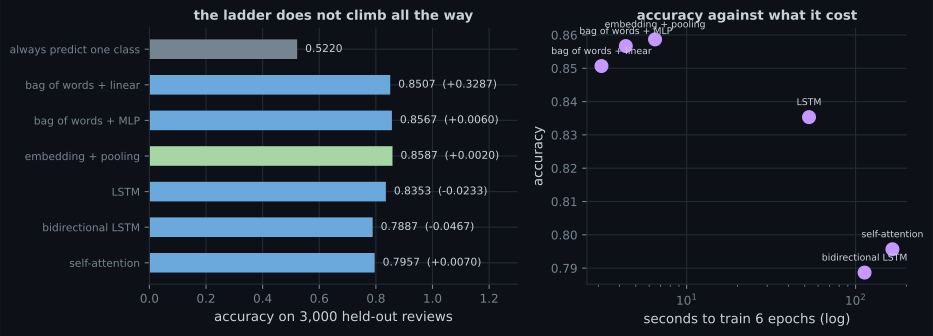
The honest reading is not “recurrence does not work for sentiment”. It is more specific and more useful:
At 6,000 reviews and 6 epochs, a bag of words is the right model. Sentiment classification is
substantially a matter of which words appear — terrible, superb, waste — and that is exactly
what a multi-hot vector encodes. Word order carries additional signal, but extracting it requires
learning an embedding and a sequence function from the same 6,000 examples, and there is not
enough data to do both.
Three things would change the answer, and none of them are architectural:
- More data. The published results that make LSTMs look good on IMDB use 25,000 training reviews, roughly 4× what is used here.
- More epochs. The recurrent models are still improving at 6 epochs while the bag of words has converged; they are undertrained, not incapable.
- Pretrained embeddings. The sequence models are learning word meanings from scratch, which is the expensive part and the part self-supervised pretraining exists to remove.
Stating those explicitly is part of the deliverable. A result of “the LSTM lost” without them is a claim about LSTMs; with them it is a claim about this budget.
Test the specific claim
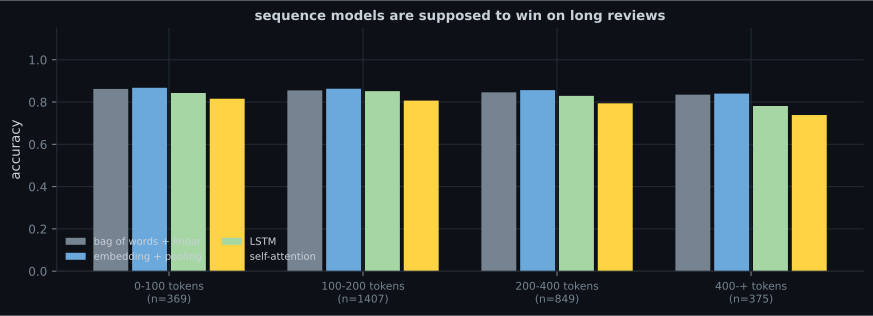
Section titled “Test the specific claim”Recurrence claims to use word order, which should matter most where a bag of words has the most to lose: long reviews, where the same words could support either sentiment depending on arrangement. So split the test set by true review length:
| Model | 0–100 | 100–200 | 200–400 | 400+ |
|---|---|---|---|---|
| Bag of words + linear | 0.8618 | 0.8550 | 0.8457 | 0.8347 |
| Embedding + pooling | 0.8672 | 0.8628 | 0.8563 | 0.8400 |
| LSTM | 0.8428 | 0.8515 | 0.8292 | 0.7813 |
| Self-attention | 0.8157 | 0.8067 | 0.7939 | 0.7387 |
Every model degrades on long reviews, which is expected — 43.3% of reviews are truncated at the 200-token window, so the longest ones are being judged on their first half. But the sequence models degrade fastest, and self-attention worst of all at 0.7387.
A recurrent model has to carry information across more timesteps on a long review, and with 6,000 examples it has not learned to do that reliably. The bag of words has no such problem: its representation of a 400-token review is exactly as easy to classify as its representation of a 50-token one.
  flowchart TD
  R["6,000 IMDB reviews"] --> B["bag of words
0.8507 in 3s"]
  R --> S["sequence models
0.7887 to 0.8353 in 53-165s"]
  B --> Q{"why did the simple
model win?"}
  S --> Q
  Q --> D["not enough data to learn
embeddings AND a sequence function"]
  Q --> T["43.3% of reviews truncated
at the 200-token window"]
  Q --> E["6 epochs: the recurrent models
are still improving"]
The best model is not the best accuracy
Section titled “The best model is not the best accuracy”The two families disagree on 8.2% of reviews, and they are not the same 8.2%:
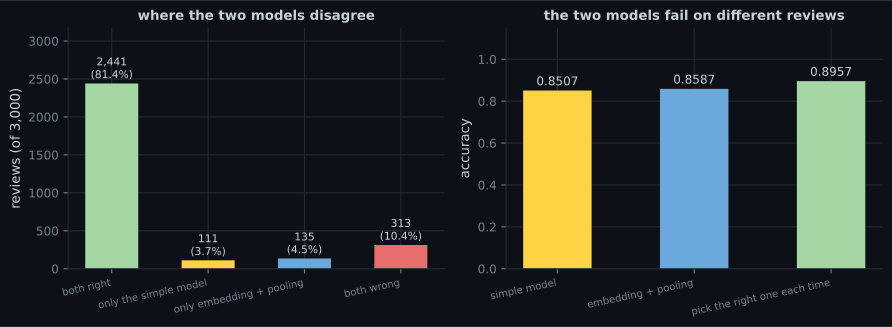
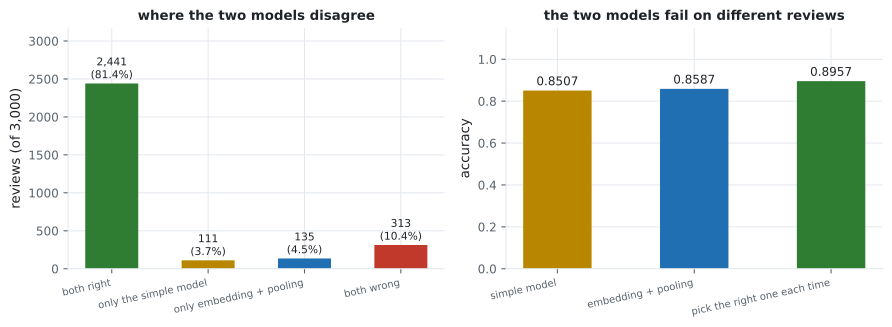
| Outcome | Reviews | Share |
|---|---|---|
| Both right | 2,441 | 81.4% |
| Only bag of words | 111 | 3.7% |
| Only embedding + pooling | 135 | 4.5% |
| Both wrong | 313 | 10.4% |
| Oracle (pick the better one) | — | 0.8957 |
The 10.4% both models fail is the genuinely hard remainder — sarcasm, mixed reviews, reviews about a film’s subject rather than its quality. No amount of architecture search moves those; better data or a fundamentally stronger model would.
The 8.2% one model gets and the other misses is the opportunity. Averaging the two models’ probabilities is a two-line change and captures part of that 0.0370.
What to hand in
Section titled “What to hand in”- The full ladder including the rungs that lost. “We tried an LSTM and it scored 0.8353” is a result; omitting it is not.
- The budget beside every number. 6,000 reviews, 6 epochs, 200-token window, 43.3% truncated. Every conclusion here is conditional on those.
- One test of the specific claim, not just overall accuracy. The length breakdown is what turns “the LSTM lost” into “the LSTM lost by more where it should have won”.
- The disagreement analysis, with the oracle number.
- What you would change, with reasons: more data, more epochs, pretrained embeddings — in that order, because that is the order of expected effect.
Pitfalls
Section titled “Pitfalls”- Assuming the fancier model wins. Six seconds of bag of words beat 165 seconds of self-attention by 0.0550.
- Reporting only the winning rung. The negative gains are the finding.
- Concluding “LSTMs are bad at sentiment”. They are bad at sentiment with 6,000 examples and 6 epochs, which is a different claim.
- Ignoring truncation. 43.3% of reviews exceed the window, so every model reads only part of the longest ones.
- Comparing accuracy without comparing cost. 0.0080 of accuracy for 55× the training time.
- Stopping at the accuracy numbers. The oracle at 0.8957 is 0.0370 above the best single model and only visible from the disagreement table.
- Using
mask_zero=Falsewith padded sequences. The model then spends capacity modelling padding, which is pure loss on a dataset where 43.3% of rows are padded or truncated.
- The ladder stopped at rung three: bag of words 0.8507, pooling 0.8587, then three sequence models at 0.7887–0.8353.
- A linear model with no word-order information at all reached 0.8507 in 3 seconds.
- The sequence models lost by more on long reviews (0.7387 for attention at 400+ tokens), the opposite of what recurrence predicts.
- 43.3% of reviews are truncated at 200 tokens, which limits every model on this page.
- The two families disagree on 8.2% of reviews; an oracle would score 0.8957.
- The result is about this budget, and the page says what would have to change.
The third capstone changes the question entirely: when there is no accuracy to report, what does a defensible result even look like? Capstone 3 - A Generative Model You Can Defend.
-
A bag-of-words linear model scored 0.8507 in 3 seconds while self-attention scored 0.7957 in 165 seconds. What is the correct conclusion?
The published results that favour sequence models on IMDB use roughly four times this data. The finding is about the budget, and the page states what would change it.
pch.quizShowAnswer
B — At 6,000 reviews and 6 epochs a bag of words is the right model — sentiment is largely about which words appear, and there is not enough data to learn embeddings and a sequence function together — The published results that favour sequence models on IMDB use roughly four times this data. The finding is about the budget, and the page states what would change it.
-
On reviews of 400+ tokens the bag of words scored 0.8347 and the LSTM 0.7813. Why is that particularly damaging to the case for recurrence?
Testing the specific claim a technique makes, rather than just overall accuracy, is what turns 'it lost' into 'it lost where it should have won'.
pch.quizShowAnswer
B — Long reviews are exactly where word order should matter most, so the sequence models losing by MORE there is the opposite of the prediction they are supposed to satisfy — Testing the specific claim a technique makes, rather than just overall accuracy, is what turns 'it lost' into 'it lost where it should have won'.
-
An oracle picking the better of two models per review would score 0.8957 against 0.8587 for the best single model. What does that justify?
The oracle is not directly achievable, but averaging the two models' probabilities captures part of it and is a two-line change.
pch.quizShowAnswer
B — An ensemble — the 0.0370 gap exists because 246 reviews are solved by exactly one of the two models, so their errors are not the same errors — The oracle is not directly achievable, but averaging the two models' probabilities captures part of it and is a two-line change.
-
43.3% of reviews exceed the 200-token window. How does that affect the comparison?
Every model sees the same truncated input, so the ranking is fair; the truncation matters because it bounds the achievable accuracy and explains part of the drop on long reviews.
pch.quizShowAnswer
B — It limits every model equally — all of them read only the first 200 tokens of the longest reviews — but it must be reported, since it caps what any of them could achieve — Every model sees the same truncated input, so the ranking is fair; the truncation matters because it bounds the achievable accuracy and explains part of the drop on long reviews.
-
What should be reported when a ladder stops climbing?
Omitting the rungs that lost turns a measurement into an advertisement, and it hides the information that would let someone else make a different budget decision.
pch.quizShowAnswer
B — The whole ladder including the negative gains, the budget every number is conditional on, and what you would change — the failed rungs are the finding — Omitting the rungs that lost turns a measurement into an advertisement, and it hides the information that would let someone else make a different budget decision.
🧪 Try It Yourself
Section titled “🧪 Try It Yourself”pch.coffeeTagline
pch.coffeeCtapch.feedbackHeading
pch.feedbackSubheading