
Subword Tokenization (BPE and WordPiece)
The previous page ended on an unavoidable trade: a 10,000-word vocabulary discards 5.5% of the text, and a 20,000-word one doubles the embedding matrix to get that down to 2.4%. Both numbers are bad, and both are consequences of insisting that the unit of text is a word.
Subword tokenization removes the choice. Build a vocabulary of pieces — frequent words stay whole, rare words split into parts, and anything unseen is spelled out of characters. Measured on 39,563 IMDB word types:
| Tokenization | Vocabulary | Tokens per review | OOV rate |
|---|---|---|---|
| character | 83 | 1,211.3 | 0.0000 |
| BPE (2,000 merges) | 2,070 | 324.7 | 0.0000 |
| word | 39,563 | 226.0 | 0.0293 at 20,000 words |
A 2,070-piece vocabulary — 5% the size of the word vocabulary — represents every word ever written, for 1.44× the sequence length.
What you’ll learn
Section titled “What you’ll learn”- The BPE algorithm in full, and why it is about forty lines.
- What the first merges actually learn:
'e' + '</w>', then's' + '</w>', then't' + 'h'. - How the vocabulary/length trade moves with merges: 5.2155 pieces per word at 1 merge, 1.4651 at 2,000.
- Why the OOV rate is exactly zero rather than merely small.
- How BPE splits words it has never seen — including
antidisestablishmentarianism. - The difference between BPE, WordPiece, Unigram and SentencePiece.
- The implementation trap that made the first version of this page time out.
The algorithm
Section titled “The algorithm”- Split every word into characters, plus an end-of-word marker
</w>. - Count every adjacent pair of pieces across the corpus, weighted by word frequency.
- Merge the most frequent pair everywhere; that merged symbol joins the vocabulary.
- Repeat for as many merges as you want vocabulary entries.
splits = {word: tuple(list(word) + ["</w>"]) for word in counts}
for step in range(merges):
    pairs = Counter()
    for word, pieces in splits.items():
        for pair in zip(pieces, pieces[1:]):
            pairs[pair] += counts[word]          # weight by word frequency
    pair, frequency = pairs.most_common(1)[0]
    if frequency < 2:
        break
    splits = {word: apply(pieces, pair) for word, pieces in splits.items()}
The end-of-word marker matters more than it looks. Without it, est in establish and
est in fastest are the same piece, and the tokenizer cannot tell a prefix from a
suffix.
Learned on this corpus, the first fifteen merges are:
| # | Merge | # | Merge | # | Merge |
|---|---|---|---|---|---|
| 1 | e + </w> | 6 | i + n | 11 | o + n |
| 2 | s + </w> | 7 | r + </w> | 12 | e + n |
| 3 | t + h | 8 | a + n | 13 | o + </w> |
| 4 | t + </w> | 9 | y + </w> | 14 | e + r |
| 5 | d + </w> | 10 | th + e</w> | 15 | i + s</w> |
BPE has discovered, in order: English words end in e and s; th is the most common
digraph; and by merge 10 it has built the word the. Nobody told it any of that — it is
counting.
Vocabulary against sequence length
Section titled “Vocabulary against sequence length”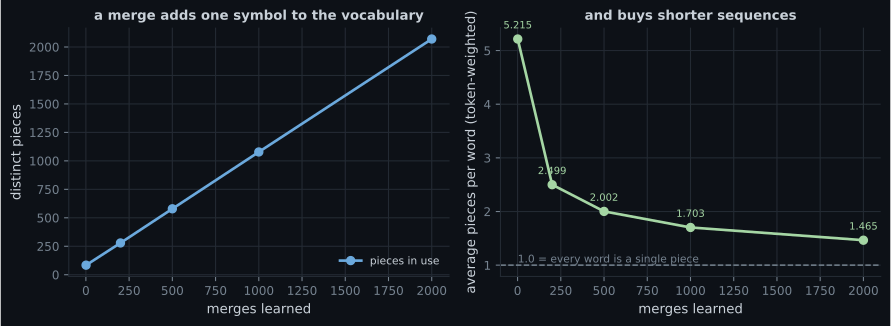
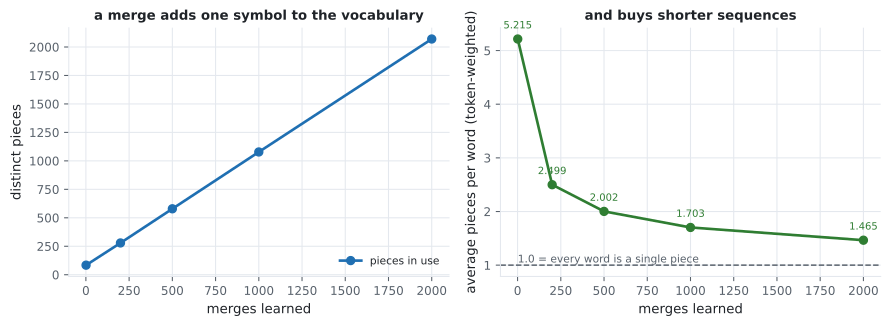
| Merges | Pieces in use | Pieces per word | Words kept whole |
|---|---|---|---|
| 1 | 84 | 5.2155 | 60 |
| 200 | 279 | 2.4994 | 1,284 |
| 500 | 579 | 2.0020 | 2,878 |
| 1,000 | 1,078 | 1.7026 | 5,043 |
| 2,000 | 2,070 | 1.4651 | 8,367 |
“Pieces per word” is token-weighted, so it answers the question you actually care about: how much longer does my sequence get? At 2,000 merges the answer is 1.47× — and 8,367 of the 39,563 word types are single pieces, which will be the common ones.
The measurement that settles it
Section titled “The measurement that settles it”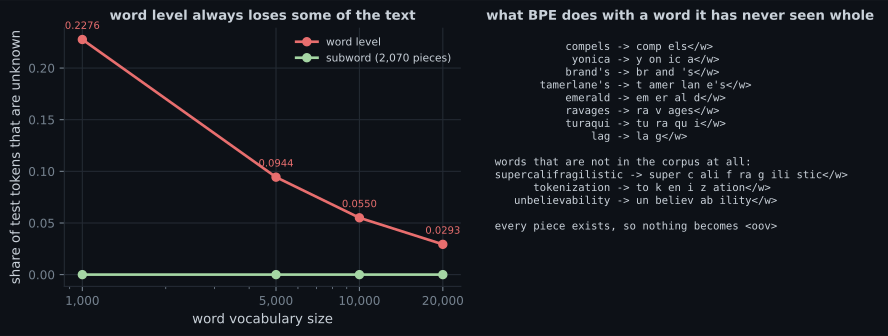
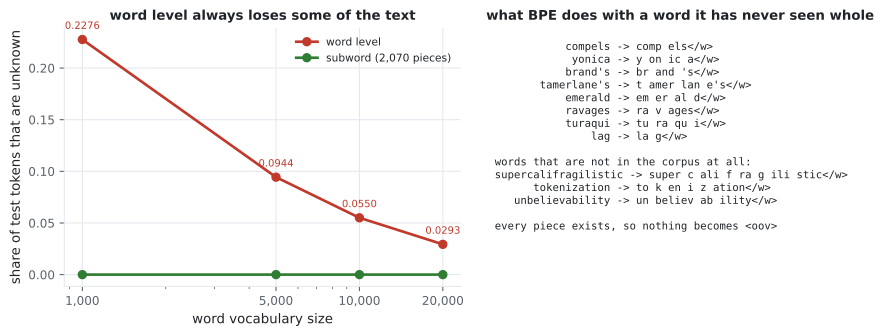
| Word vocabulary | Word-level OOV | BPE OOV |
|---|---|---|
| 1,000 | 0.2276 | 0.0000 |
| 5,000 | 0.0944 | 0.0000 |
| 10,000 | 0.0550 | 0.0000 |
| 20,000 | 0.0293 | 0.0000 |
The zero is exact, not rounded, and the reason is structural: the vocabulary contains every character in the corpus, so the worst case for any word is that it is spelled out.
                tokenization -> to k en i z ation</w>
             unbelievability -> un believ ab ility</w>
        supercalifragilistic -> super c ali f ra g ili stic</w>
antidisestablishmentarianism -> an ti di se st ab li sh m ent ari an ism</w>
Read those splits carefully, because they show both the strength and the limit:
un believ ab ilityis close to a morphological analysis, and it was learned from frequency counts alone.to k en i z ationis not. BPE is greedy and frequency-driven, not linguistic; it foundationbut mangled the stem.antidisestablishmentarianismbecomes 13 pieces. A word the tokenizer has never seen costs sequence length, which is the price of never failing.
The length trade
Section titled “The length trade”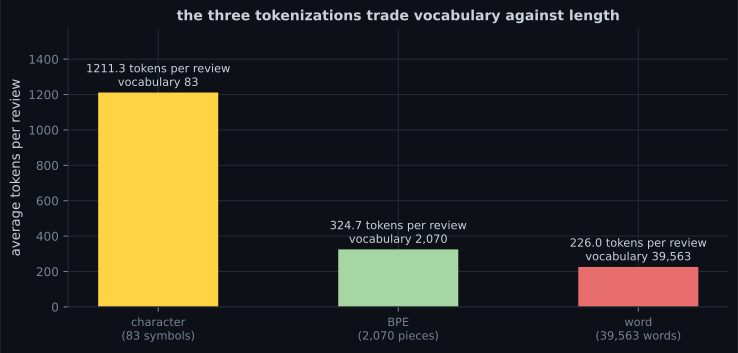
For a transformer this trade is sharper than it looks, because attention cost grows with the square of the token count. Character tokenization at 5.36× the length is 28.73× the attention cost; BPE at 1.44× is 2.06×. Exercise 5 works the whole table, including the embedding matrices: 21,248 parameters for characters against 10,128,128 for words at 256 dimensions.
  flowchart LR
  A["word level"] -->|"OOV never reaches 0
huge embedding matrix"| D["subword"]
  B["character level"] -->|"5.36x length
28x attention cost"| D
  D --> E["BPE
merge most frequent pair"]
  D --> F["WordPiece
merge highest likelihood gain"]
  D --> G["Unigram
start big, prune"]
  E --> H["vocabulary 2,070
1.44x length
0% OOV"]
  F --> H
  G --> H
The four you will meet
Section titled “The four you will meet”| Algorithm | Merge/keep criterion | Used by |
|---|---|---|
| BPE | most frequent adjacent pair | GPT-2, RoBERTa, most LLMs |
| WordPiece | pair maximising — likelihood gain, not raw count | BERT, DistilBERT |
| Unigram | start with a large vocabulary, prune the pieces that cost least likelihood | T5, ALBERT |
| SentencePiece | not an algorithm — a wrapper that treats the input as raw bytes, so no pre-tokenizer is needed | multilingual models |
The difference between BPE and WordPiece is one line of the algorithm. BPE takes the
pair that occurs most; WordPiece takes the pair whose merger most increases the corpus
likelihood, which favours pairs that are common together relative to how common they
are apart. In practice their outputs are similar, and the marker convention differs more
visibly: BPE typically marks word ends (ation</w>), WordPiece marks continuations
(##ation).
The implementation trap
Section titled “The implementation trap”The obvious BPE implementation recounts every pair after every merge. That is quadratic, and on this corpus — 39,563 words, 2,000 merges — it never finished; the module timed out at ten minutes.
Only the words containing the merged pair can change, so keeping a pair → words index
and updating locally turns it into 5.1 seconds for 200 merges. The second trap is at
encoding time: replaying all 2,000 merges for each of ~100,000 tokens is another 2×10⁸
operations, when training has already computed the final split for every word in the
corpus. Look it up; only genuinely unseen words need the replay.
Pitfalls
Section titled “Pitfalls”- Forgetting the end-of-word marker. Without it the tokenizer cannot distinguish a
suffix from a prefix, and
estinfastestmerges withestinestablish. - Recounting all pairs after every merge. Quadratic; it did not finish on 39,563
words. Keep a
pair → wordsindex. - Replaying every merge to encode a known word. Training already produced its split.
- Assuming subword splits are morphemes.
un believ ab ilitylooks linguistic;to k en i z ationshows it is frequency, not grammar. - Ignoring the sequence-length cost. 1.44× the tokens is 2.1× the attention cost, and character level’s 5.36× is 28×.
- Training the tokenizer on the test set. It is a model fitted to a corpus, with the same leakage rules as any other.
- Comparing models across different tokenizers. Perplexity per token is not comparable when the tokens are different sizes — a point the evaluation page returns to.
- BPE: split into characters, repeatedly merge the most frequent adjacent pair. About forty lines.
- The first merges learned on this corpus were
e</w>,s</w>,th, and by merge 10 the wordthe. - 2,000 merges gave 2,070 pieces, 1.4651 pieces per word, and 8,367 of 39,563 word types kept whole.
- OOV rate on 458,707 test tokens: 0.0000 for BPE at 2,070 pieces, against 0.0293 for a 20,000-word vocabulary.
- Sequence length per review: character 1,211.3, BPE 324.7, word 226.0.
- BPE merges by frequency, WordPiece by likelihood gain, Unigram prunes downward, SentencePiece removes the pre-tokenizer.
With a tokenization that never fails, the question becomes how to turn those tokens into features. The oldest answer still beats a lot of neural models: Bag of Words (BoW) & TF-IDF.
-
A BPE vocabulary of 2,070 pieces had an OOV rate of exactly 0.0000, while a 20,000-word vocabulary had 0.0293. Why is the zero exact rather than merely small?
It is a structural guarantee, not a lucky measurement — which is why subword tokenization replaced word-level tokenization everywhere.
pch.quizShowAnswer
B — Because the vocabulary contains every character in the corpus, so the worst case for an unknown word is that it is spelled out piece by piece — It is a structural guarantee, not a lucky measurement — which is why subword tokenization replaced word-level tokenization everywhere.
-
The first merges learned were 'e'+'</w>', then 's'+'</w>', then 't'+'h'. What does that show?
By merge 10 it had assembled 'the'. The structure it finds is statistical, which is also why 'tokenization' splits as 'to k en i z ation'.
pch.quizShowAnswer
B — Nothing was taught — BPE counts adjacent pairs, and English word endings and the 'th' digraph are simply the most frequent pairs in the corpus — By merge 10 it had assembled 'the'. The structure it finds is statistical, which is also why 'tokenization' splits as 'to k en i z ation'.
-
Character tokenization needs only 83 symbols and never has an OOV. Why is it not the obvious choice for a transformer?
BPE's 1.44x length is only 2.1x attention cost, which is why the middle ground won.
pch.quizShowAnswer
B — It produced 5.36x the sequence length, and attention cost grows with the square of the token count — about 28x the attention compute — BPE's 1.44x length is only 2.1x attention cost, which is why the middle ground won.
-
What is the difference between BPE and WordPiece?
One line of the algorithm. The visible difference is usually the marker convention: 'ation</w>' against '##ation'.
pch.quizShowAnswer
B — The merge criterion: BPE takes the most frequent adjacent pair, WordPiece takes the pair whose merger most increases corpus likelihood — One line of the algorithm. The visible difference is usually the marker convention: 'ation</w>' against '##ation'.
-
The first implementation of this page's BPE timed out after ten minutes. What was wrong?
With the index it runs 200 merges in 5.1 seconds. The second trap is encoding: reuse the splits training already computed rather than replaying all merges per token.
pch.quizShowAnswer
B — It recounted every pair in the corpus after every merge — but only the words containing the merged pair can change, so a pair-to-words index makes it fast — With the index it runs 200 merges in 5.1 seconds. The second trap is encoding: reuse the splits training already computed rather than replaying all merges per token.
🧪 Try It Yourself
Section titled “🧪 Try It Yourself”pch.coffeeTagline
pch.coffeeCtapch.feedbackHeading
pch.feedbackSubheading