
Padding, Masking and Variable-Length Sequences
Real sequences have different lengths. Tensors do not. Every sequence model therefore starts with a compromise — pad everything to one length — and that compromise introduces a bug you cannot see in the loss curve, only in the score.
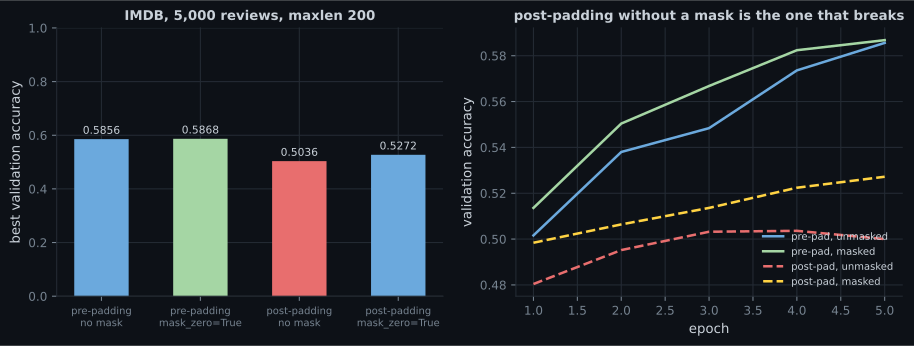
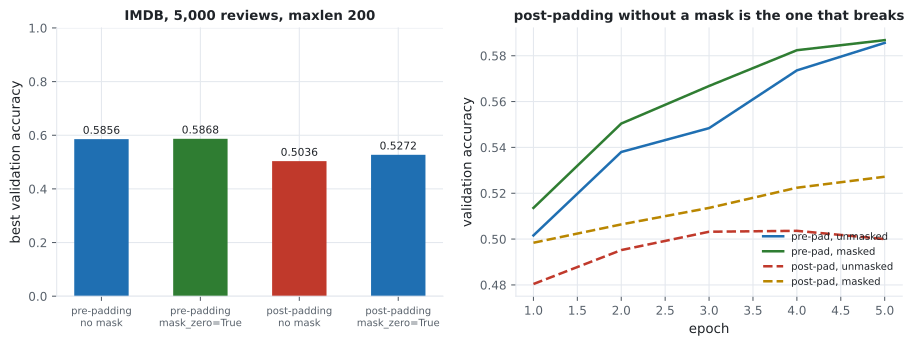
Here is the headline, measured on 5,000 IMDB reviews with an identical
SimpleRNN(32), five epochs, four setups:
| Padding | mask_zero | Best validation accuracy |
|---|---|---|
| pre | False | 0.5856 |
| pre | True | 0.5868 |
| post | False | 0.5036 |
| post | True | 0.5272 |
Three of those runs learn something. One of them scores chance on a balanced binary task, and nothing in the code looks wrong.
What you’ll learn
Section titled “What you’ll learn”- What
pad_sequencesdoes, and whymaxlenis a two-sided trade: at 50 tokens you keep 0.2045 of the text; at 800 tokens 0.6987 of your batch is padding. - Why post-padding without a mask destroys a recurrent model but pre-padding survives.
- What
mask_zero=Trueactually produces — a boolean tensor travelling alongside the data, not zeroed values. - Which layers respect a mask and which silently ignore it.
- Why an unmasked
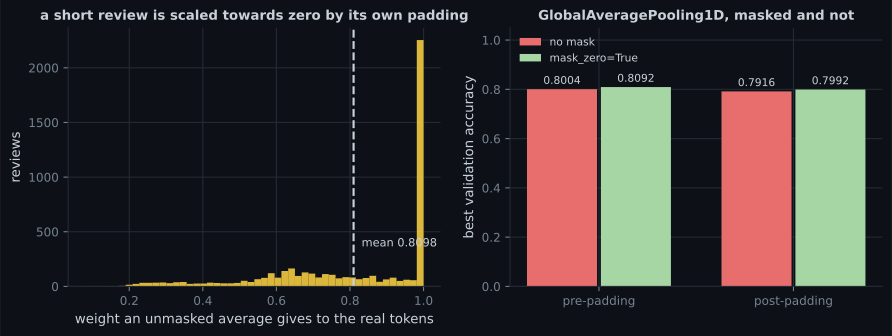
GlobalAveragePooling1Ddivides every review by the wrong number: the mean weight on real tokens was 0.8098, and the shortest review got 0.0800. - Bucketing and
raggedtensors, and when the padding is cheap enough not to care.
pad_sequences and the cost of maxlen
Section titled “pad_sequences and the cost of maxlen”IMDB reviews, 5,000 of them: min 16 tokens, median 182, mean 243.8, p95 633, max 1,851. One tensor has to hold all of them.
x = keras.preprocessing.sequence.pad_sequences(
    sequences,
    maxlen=200,        # every row becomes exactly this long
    padding="pre",     # where the zeros go:      "pre" = front, "post" = back
    truncating="pre",  # which end is cut off if the row is too long
)
maxlen | Share of the batch that is padding | Share of real tokens kept | Rows truncated |
|---|---|---|---|
| 50 | 0.0030 | 0.2045 | 0.9802 |
| 100 | 0.0332 | 0.3965 | 0.8944 |
| 200 | 0.1902 | 0.6642 | 0.4386 |
| 400 | 0.4642 | 0.8790 | 0.1506 |
| 800 | 0.6987 | 0.9887 | 0.0206 |
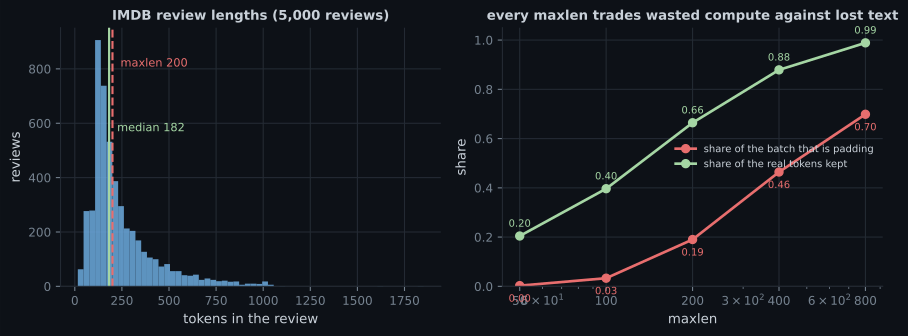
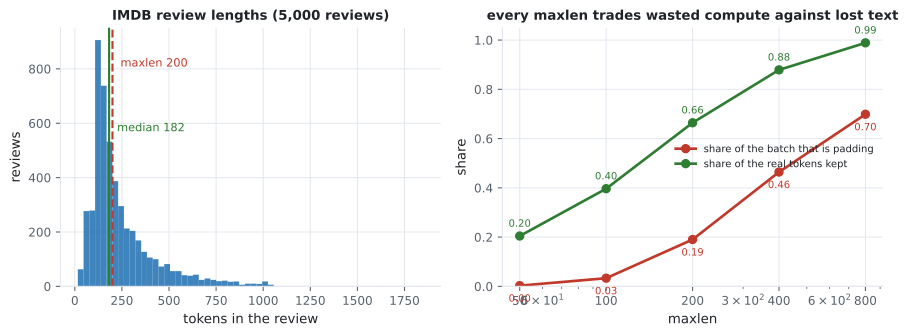
Padding is not free even when it is harmless: at maxlen=800 a recurrent layer runs
800 timesteps sequentially, of which 559 carry no information.
Why post-padding breaks a recurrent layer
Section titled “Why post-padding breaks a recurrent layer”A recurrent layer’s output is its last hidden state. That is the whole explanation.
  flowchart LR
  subgraph pre["pre-padding: 0 0 0 great film"]
    A["h after zeros"] --> B["h after 'great'"] --> C["h after 'film'
= output"]
  end
  subgraph post["post-padding: great film 0 0 0"]
    D["h after 'great'"] --> E["h after 'film'"] --> F["h after zeros
= output"]
  end
With pre-padding the padding comes first, and whatever the state accumulated over those zeros is then overwritten by the actual review. The last step is a real word, so the output is about the review.
With post-padding the last step is padding. For a review 68 tokens long inside a 200-step tensor, the network’s answer is the state after 132 consecutive padding steps — and every one of those steps multiplies the state by the recurrent weights again. Whatever the review contributed decays away, and the measured result is 0.5036: chance.
The default is the safe one, and that is why this bug hides
Section titled “The default is the safe one, and that is why this bug hides”pad_sequences defaults to padding="pre". Most tutorials therefore work without ever
mentioning masking — and the first time you write padding="post" because a
transformer tutorial told you to, your accuracy quietly halves.
What mask_zero actually does
Section titled “What mask_zero actually does”It does not zero the padded vectors. It attaches a boolean tensor to the output that downstream layers may consult:
embedding = keras.layers.Embedding(10000, 4, mask_zero=True)
sample = np.array([[0, 0, 7, 9],
                   [4, 5, 6, 8]])
embedded = embedding(sample)                   # (2, 4, 4) — real numbers everywhere
mask = embedding.compute_mask(sample).numpy()
# [[False False  True  True]
#  [ True  True  True  True]]
With mask_zero=False, compute_mask returns None — there is no mask to ignore,
which is why the failure is silent rather than an error.
Measured on a freshly seeded layer: the padded position’s embedding vector has , not zero. Token id 0 is an ordinary row of the embedding matrix and it gets ordinary gradients like any other. The mask is metadata; a layer that ignores it sees those numbers as data.
| Layer | Respects a mask? |
|---|---|
SimpleRNN, LSTM, GRU | yes — stops updating the state at masked steps and repeats the last real state |
Bidirectional | yes, in both directions |
GlobalAveragePooling1D | yes — since TF 2.x it divides by the unmasked count |
GlobalMaxPooling1D | no in older versions; check your version |
Dense, Conv1D | no — they process every position identically |
Flatten | no, and it destroys the mask |
MultiHeadAttention | only if you pass attention_mask yourself |
The two dangerous rows are Conv1D and Dense: they consume the padded vectors as
though they were words, and they never complain.
Pooling: the dilution nobody notices
Section titled “Pooling: the dilution nobody notices”GlobalAveragePooling1D over an unmasked padded batch computes
where is the true length and is maxlen. Every review is scaled by
— a factor that varies per row and encodes nothing but length.
Two honest observations about that measurement:
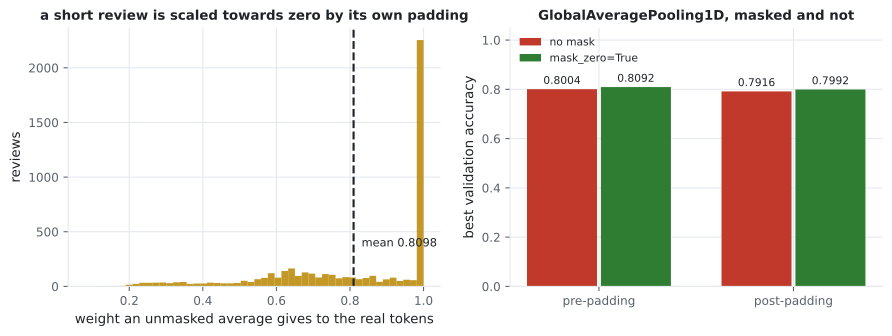
- The gain is small. +0.0088 is not the difference between working and broken. A trained embedding can push the padding token towards zero and partly cancel the dilution itself, which is exactly what it does here.
- It is still worth taking. One keyword, no cost, and it removes a length signal the model was free to abuse. On tasks where sequence length correlates with the label — support tickets, medical notes — an unmasked average lets the model cheat by reading the length instead of the content.
Also worth noting: the averaging model scored 0.8004, while the best
SimpleRNN(32) on this page managed 0.5868. Averaging the embeddings and throwing
away all order beat the recurrent layer by 0.21. That is not a masking result, it is a
warning about SimpleRNN over 200 timesteps — the subject of the
next page.
Alternatives to one big rectangle
Section titled “Alternatives to one big rectangle”| Approach | How | When |
|---|---|---|
Pad to a global maxlen | pad_sequences | default; simple, wasteful on skewed data |
| Bucketing by length | tf.data + bucket_by_sequence_length | long-tailed lengths; each batch pads to its own longest row |
| Ragged tensors | tf.ragged.constant, keras.layers.Input(ragged=True) | genuinely variable length, layers that support it |
| Truncate hard | small maxlen | when the signal is front-loaded — sentiment often is |
Bucketing is the practical win, and Exercise 6 measures it: padding all 5,000 reviews to the longest one (1,851 tokens) makes 0.8683 of the batch padding; five length buckets bring that to 0.3207 — 0.5476 of the compute recovered with no change to the model and no text discarded.
dataset = tf.data.Dataset.from_generator(...)          # variable-length rows
dataset = dataset.bucket_by_sequence_length(
    element_length_func=lambda x, y: tf.shape(x)[0],
    bucket_boundaries=[100, 200, 400, 800],
    bucket_batch_sizes=[64, 64, 32, 16, 8],            # one more than boundaries
)Pitfalls
Section titled “Pitfalls”padding="post"with a recurrent layer and no mask. Measured 0.5036 — chance — with no error, no warning and a smooth loss curve.- Assuming
mask_zero=Truezeroes the padded vectors. It does not: the measured padded embedding had . It attaches a boolean mask that layers may ignore. - Putting
FlattenorDenseafter a masked embedding. The mask is dropped and every padded position becomes a feature. - Reserving id 0 for a real token.
mask_zero=Truemeans id 0 is padding. If your vocabulary starts at 0, every occurrence of that word is masked away. - Choosing
maxlenfrom the maximum length. At 800 here, 69.9% of the batch is padding to accommodate a 1,851-token tail. Use a percentile — p95 was 633 — or bucket. - Truncating the wrong end.
truncating="pre"keeps the end of the text. For sentiment that is often right; for a news headline task it is exactly wrong. - Comparing a padded model against an unpadded baseline. The padded model sees less text; that is a data difference, not an architecture result.
pad_sequences(maxlen=..., padding=..., truncating=...)is the only place these decisions are made, and its defaults (pre,pre) are the safe ones for RNNs.- On 5,000 IMDB reviews:
maxlen=200keeps 0.6642 of the tokens and spends 0.1902 of the batch on padding;maxlen=800keeps 0.9887 and spends 0.6987. - A recurrent layer outputs its last hidden state, so post-padding hands the classifier the state after the zeros: 0.5036 against 0.5856 for pre-padding.
mask_zero=Trueattaches a boolean mask; RNNs,BidirectionalandGlobalAveragePooling1Dhonour it, whileDense,Conv1DandFlattendo not.- An unmasked average weights the real tokens by — mean 0.8098, minimum 0.0800 in this sample — and masking bought +0.0088.
- Bucketing by length is the fix that scales: padding everything to 1,851 tokens wastes 0.8683 of the batch, five buckets waste 0.3207.
SimpleRNN managed 0.5868 here while averaging the embeddings scored 0.8004. The
gates that fix it — and the exact reason a plain recurrent state cannot hold
information for 200 steps — are next:
LSTM & GRU Networks.
-
An identical SimpleRNN scored 0.5856 with pre-padding and 0.5036 with post-padding. Why?
0.5036 on a balanced binary task is chance, and nothing in the code or the loss curve indicates a problem.
pch.quizShowAnswer
B — A recurrent layer's output is its last hidden state — with post-padding that state is the one after all the zeros, so the review's contribution has decayed away — 0.5036 on a balanced binary task is chance, and nothing in the code or the loss curve indicates a problem.
-
What does mask_zero=True actually do to the padded positions?
Which is why a Dense or Conv1D layer after the embedding happily consumes padding as data.
pch.quizShowAnswer
B — Nothing to the values — the measured padded vector still had sum|v| = 0.1477. It attaches a boolean mask tensor that downstream layers may consult — Which is why a Dense or Conv1D layer after the embedding happily consumes padding as data.
-
On this corpus, maxlen=800 keeps 0.9887 of the real tokens. What does it cost?
The 1,851-token maximum dictates that setting for the sake of a handful of rows; the p95 was 633 and bucketing avoids the choice entirely.
pch.quizShowAnswer
B — 0.6987 of every batch becomes padding, and a recurrent layer runs all 800 timesteps sequentially, so most of the compute processes zeros — The 1,851-token maximum dictates that setting for the sake of a handful of rows; the p95 was 633 and bucketing avoids the choice entirely.
-
An unmasked GlobalAveragePooling1D over pre-padded reviews gave the real tokens a mean weight of 0.8098, and 0.0800 for the shortest review. What is the risk?
Masking bought only +0.0088 here because the trained embedding partly cancels the dilution itself, but the fix is one keyword and it removes the shortcut.
pch.quizShowAnswer
B — Every review is scaled by its own length/maxlen ratio, which injects a length signal the model can use instead of the content — and short reviews are mostly the padding embedding — Masking bought only +0.0088 here because the trained embedding partly cancels the dilution itself, but the fix is one keyword and it removes the shortcut.
-
Which of these layers will silently treat padded positions as real data?
Recurrent layers, Bidirectional and modern GlobalAveragePooling1D honour the mask; convolutional and dense layers process every position identically.
pch.quizShowAnswer
B — Conv1D and Dense — neither consults the mask, and Flatten destroys it — Recurrent layers, Bidirectional and modern GlobalAveragePooling1D honour the mask; convolutional and dense layers process every position identically.
🧪 Try It Yourself
Section titled “🧪 Try It Yourself”pch.coffeeTagline
pch.coffeeCtapch.feedbackHeading
pch.feedbackSubheading