
Evaluating Language Models (Perplexity and BLEU)
Every model in this phase has been scored with accuracy, which works because the answer was one of two labels. Generation has no such luxury: there are many acceptable outputs, most of them never written down, and the metric has to cope.
Two metrics dominate, and both are routinely misread. This page implements both, and the implementation is the point — perplexity gets compared across incomparable test sets, and BLEU gets quoted without the properties that make it fail.
What you’ll learn
Section titled “What you’ll learn”- Perplexity as exponentiated cross-entropy, and why uniform perplexity equals the vocabulary size.
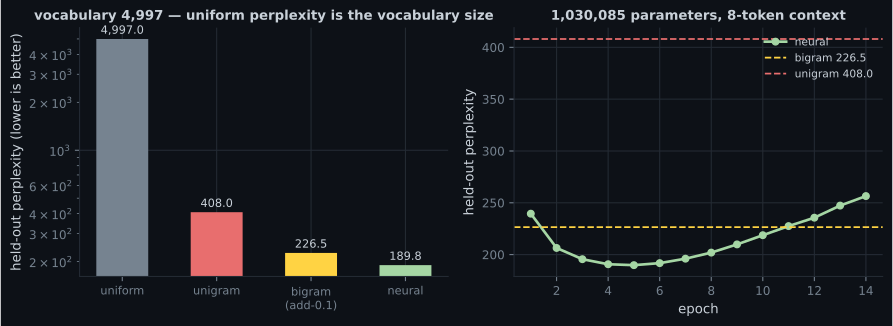
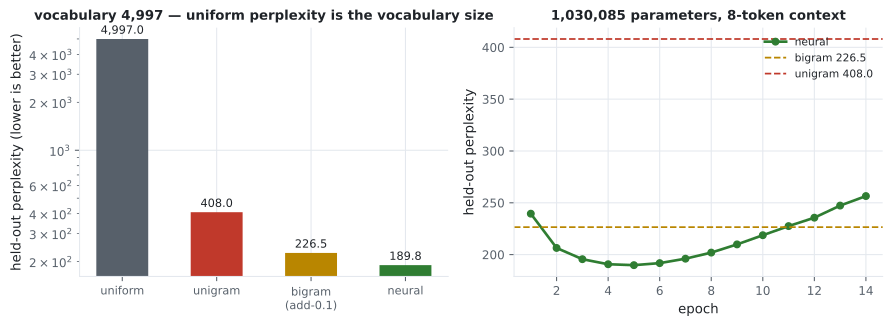
- The ladder on one shared test set: uniform 4,997 → unigram 408.05 → bigram 226.47 → neural 189.81.
- Why perplexity numbers from two papers are usually not comparable.
- Why BLEU gives a correct reordering and a correct paraphrase 0.0000.
- The brevity penalty, alone, in a table.
- What sampling temperature does to diversity and to likelihood — in opposite directions.
Perplexity
Section titled “Perplexity”It is the exponential of the average negative log-likelihood, and it has a clean reading: the effective number of equally-likely choices the model faces at each step. A model with perplexity 200 is as uncertain as someone rolling a fair 200-sided die.
That reading gives a free sanity check. A model that has learned nothing assigns every word probability , so its perplexity is exactly — measured 4,997.00 on a 4,997-word vocabulary.
| Model | Held-out perplexity | Tokens scored |
|---|---|---|
| uniform | 4,997.00 | 30,000 |
| unigram (add-0.1) | 408.05 | 30,000 |
| bigram (add-0.1) | 226.47 | 30,000 |
| neural (8-token context) | 189.81 | 30,000 |
The two ways this measurement goes wrong
Section titled “The two ways this measurement goes wrong”Both happened here before the numbers above were trustworthy.
- Scoring different test sets. The first run scored the n-gram models on all 231,210 held-out tokens and the neural model on 30,000 windows, then printed them in one table. Perplexity is an average over whatever you scored, so that comparison was meaningless. Every model above sees the identical windows.
- Reporting the final epoch. With 1,030,085 parameters — most of them in the output layer — the model overfits hard. Final-epoch perplexity was 4,062.44 in one configuration; the minimum was far lower.
And a third that cannot be fixed by being careful, only by disclosure: perplexity depends on the tokenizer. A model over 2,070 BPE pieces and a model over 39,563 words are averaging over different units, so their perplexities are not on the same scale. Comparing them is like comparing prices without saying which currency.
BLEU compares an output against one or more references by counting matching n-grams:
where is the clipped precision of -grams and is the reference length over
the candidate length. Measured against the reference 'the cat sat on the mat':
| Candidate | BLEU-4 | BP | ||||
|---|---|---|---|---|---|---|
| exact match | 1.0000 | 1.000 | 1.000 | 1.000 | 1.000 | 1.000 |
| one word changed | 0.5373 | 1.000 | 0.833 | 0.600 | 0.500 | 0.333 |
| reordered | 0.0000 | 1.000 | 1.000 | 0.800 | 0.500 | 0.000 |
| shorter but correct | 0.0000 | 0.368 | 1.000 | 1.000 | 1.000 | 0.000 |
| synonym | 0.5373 | 1.000 | 0.833 | 0.600 | 0.500 | 0.333 |
| padded with repeats | 0.6804 | 1.000 | 0.750 | 0.714 | 0.667 | 0.600 |
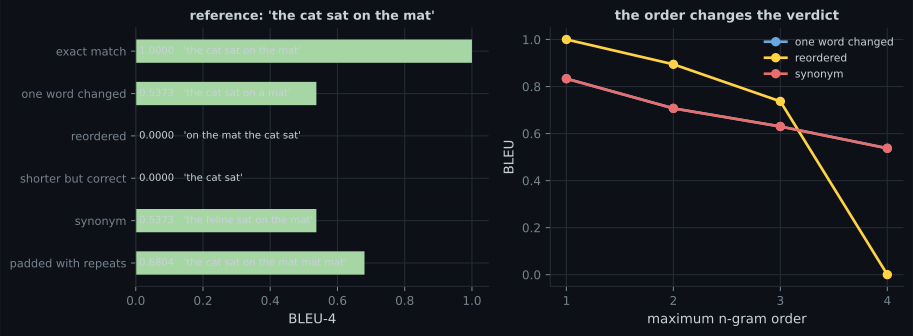
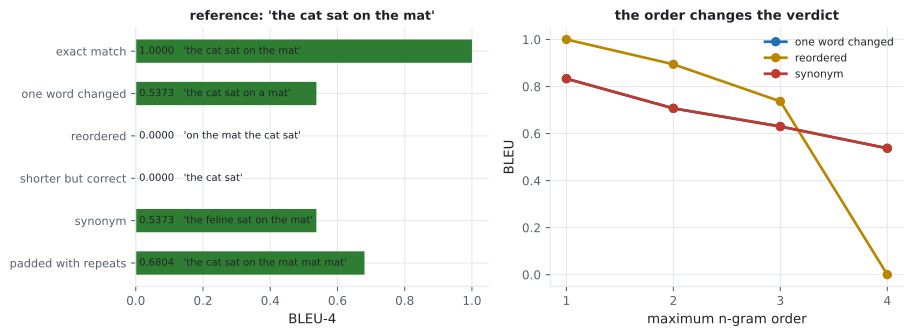
Read that last row again: a sentence padded with repeated words outscored a correct shorter one by 0.68. BLEU is a precision-based metric with a length hack bolted on, and its failures are structural rather than incidental:
- It compares surface strings.
felineforcatscores exactly as badly as a wrong word. - A single zero precision zeroes everything, because the combination is a geometric mean. Real implementations apply smoothing for this reason — usually add-1 on the counts.
- The brevity penalty is the only thing preventing degenerate short outputs, and it is asymmetric: too long is free, too short is punished exponentially.
| Candidate length | Reference length | BP |
|---|---|---|
| 3 | 6 | 0.3679 |
| 4 | 6 | 0.6065 |
| 5 | 6 | 0.8187 |
| 6 | 6 | 1.0000 |
| 7 | 6 | 1.0000 |
| 12 | 6 | 1.0000 |
BLEU is still used because on corpus-level translation with multiple references it correlates reasonably with human judgement. On single sentences with one reference — the way it is quoted in most blog posts — it is close to noise.
Temperature: diversity against likelihood
Section titled “Temperature: diversity against likelihood”Sampling divides the logits by a temperature before the softmax. Measured on 2,000 predictions from the trained model:
| Temperature | Distinct tokens | Mean top probability | Entropy | Perplexity |
|---|---|---|---|---|
| 0.2 | 69 | 0.8420 | 0.4265 | 98,041.8 |
| 0.5 | 174 | 0.5845 | 1.5489 | 1,162.6 |
| 0.8 | 493 | 0.3016 | 3.5904 | 283.5 |
| 1.0 | 714 | 0.1788 | 4.7475 | 225.5 |
| 1.5 | 1,044 | 0.0580 | 6.3151 | 243.6 |
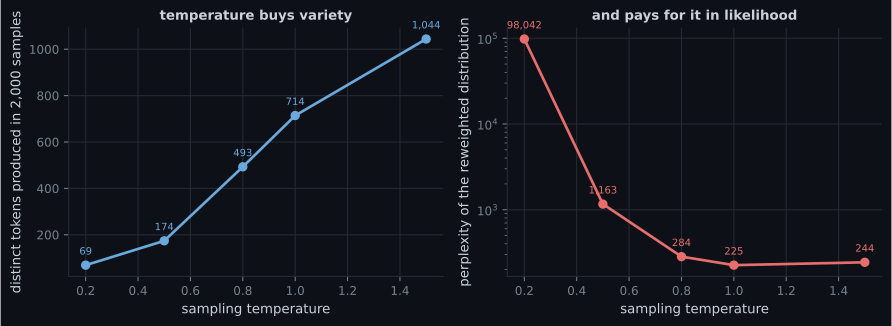
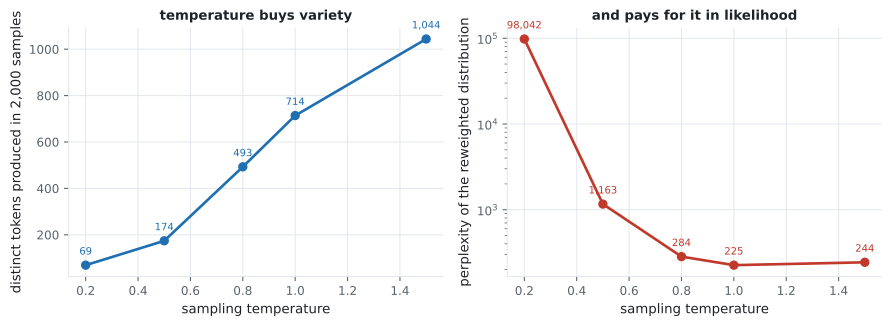
Which is the honest limitation of perplexity for generation: it is minimised at temperature 1.0, but almost nobody generates at temperature 1.0, because samples from the raw distribution wander. The setting people actually ship — 0.7–0.9, or top-p sampling — is a setting perplexity says is worse.
  flowchart TB
  A["what are you evaluating?"] --> B{"is there one correct output?"}
  B -->|"yes — classification"| C["accuracy, F1"]
  B -->|"no — generation"| D{"do you have references?"}
  D -->|"no"| E["perplexity
same tokenizer, same test set"]
  D -->|"yes, several"| F["BLEU / chrF / METEOR
corpus level, with smoothing"]
  D -->|"yes, one"| G["BLEU is close to noise here
— use human judgement or a learned metric"]
  E --> H["report the best epoch and
the tokenizer"]
  F --> H
Pitfalls
Section titled “Pitfalls”- Comparing perplexities across tokenizers. 2,070 BPE pieces and 39,563 words are different units; the numbers are not on one scale.
- Comparing perplexities across test sets. Scoring 231,210 tokens against 30,000 windows produced a table that meant nothing.
- Reporting the final epoch. The neural model’s best was 189.81 at epoch 5 and 256.49 at epoch 14 — and 4,062.44 in an unregularised configuration.
- Quoting BLEU on single sentences with one reference. A correct reordering scores 0.0000 and a padded sentence scores 0.6804.
- Using BLEU-4 without smoothing. One zero precision zeroes the whole score.
- Forgetting the brevity penalty is asymmetric. Twelve tokens against six is free; three against six costs a factor of 0.368.
- Treating a perplexity win as a generation win. Perplexity is minimised at temperature 1.0, which is not the temperature anyone generates at.
- Perplexity is exponentiated cross-entropy — the effective number of equally-likely choices per step — and a model that learned nothing scores exactly the vocabulary size (4,997.00).
- On one shared 30,000-window test set: unigram 408.05, bigram 226.47, neural 189.81.
- The neural model’s minimum was at epoch 5 of 14 (256.49 at the end): report the best epoch.
- BLEU gives a correct reordering 0.0000 and a correct paraphrase 0.5373, while a repeat-padded sentence scores 0.6804.
- The brevity penalty runs 0.3679 at half length and 1.0000 at any length above the reference.
- Temperature 0.2 cut distinct tokens from 714 to 69 and raised perplexity 435×; perplexity is minimised at exactly 1.0.
That closes the NLP phase. Generation moves from measuring text to producing images and sound: Phase 6 — Generative Deep Learning.
-
A model with a 4,997-word vocabulary that has learned nothing scores perplexity 4,997.00. Why exactly the vocabulary size?
That gives a free sanity check: any perplexity at or above the vocabulary size means the model has learned nothing usable.
pch.quizShowAnswer
B — It assigns every word probability 1/V, so exponentiated cross-entropy is exactly V — perplexity is the effective number of equally-likely choices per step — That gives a free sanity check: any perplexity at or above the vocabulary size means the model has learned nothing usable.
-
The neural model scored perplexity 189.81 at epoch 5 and 256.49 at epoch 14. Which do you report, and why does it matter?
Reporting the final epoch turned a win over the bigram into an apparent loss of thousands of perplexity points.
pch.quizShowAnswer
B — The best epoch — with 1,030,085 parameters the model overfits, and an earlier unregularised run reported 4,062.44 at the final epoch while its minimum was far lower — Reporting the final epoch turned a win over the bigram into an apparent loss of thousands of perplexity points.
-
'On the mat the cat sat' contains every unigram of 'the cat sat on the mat' and scores BLEU-4 = 0.0000. Why?
This is why real implementations smooth the counts. The same table shows a repeat-padded sentence scoring 0.6804 — higher than a correct shorter one.
pch.quizShowAnswer
B — BLEU combines n-gram precisions with a geometric mean, so a single zero — here p4, since no 4-gram survives the reordering — zeroes the whole score — This is why real implementations smooth the counts. The same table shows a repeat-padded sentence scoring 0.6804 — higher than a correct shorter one.
-
Why are two published perplexity numbers usually not comparable?
The subword page measured 2,070 pieces against 39,563 words on the same corpus — the same text, very different token counts.
pch.quizShowAnswer
B — Because perplexity is an average per token, so it depends on the tokenizer and on the test set — a model over BPE pieces and one over whole words are averaging different units — The subword page measured 2,070 pieces against 39,563 words on the same corpus — the same text, very different token counts.
-
Perplexity of the reweighted distribution was minimised at temperature 1.0 (225.5) and rose to 98,041.8 at 0.2. What does that tell you about using perplexity to tune generation?
Sharpening to 0.2 cut the vocabulary in use from 714 tokens to 69 — the numerical signature of repetition, which perplexity registers only as 'worse'.
pch.quizShowAnswer
B — Perplexity is minimised at exactly the distribution the model was trained on, so it cannot recommend the sharper settings people actually ship — it measures prediction, not sample quality — Sharpening to 0.2 cut the vocabulary in use from 714 tokens to 69 — the numerical signature of repetition, which perplexity registers only as 'worse'.
🧪 Try It Yourself
Section titled “🧪 Try It Yourself”pch.coffeeTagline
pch.coffeeCtapch.feedbackHeading
pch.feedbackSubheading